Tuesday, April 12, 2022

Saree day and cultural appreciation (not appropriation)

      Thursday was Saree Day at Fergusson College. I draped my fancier saree and took an Uber Auto rickshaw to the college. The female students normally dressed in kurtas and leggings, or salwar kameez, or t-shirts and jeans, were now decked out in vibrant, sparkling sarees—shocking pink to pale purple to crimson red to cobalt blue (most a combination of the above!). The young ladies dazzled in their finery. Long, dangling gold earrings, elaborate nose rings, and necklaces gracing the forehead (bindi) completed the look. Bindis dotted the spot between eyebrows recently plucked or threaded. Young men and women took pictures outside—in pairs, groups, or alone. It looked like young people preparing to go to prom, but in India, there was no prom. There was, however, a raucous, exuberant dance party outside the following day.
      I admired all the finely-dressed students and joined in the picture-taking. Some of my students wanted to add a bindi to my forehead—when I asked what it signified I heard a variety of responses: wisdom; married status; belonging… to a husband, or to God; fashion statement; status alert; religious devotion. All my students were thrilled to see me in a saree, and everyone who talked to me had the same query: “did you drape it yourself?” asked one. “Did you tie it on by yourself?” asked the general. They were more impressed I could put it on properly than by the fact I wanted to wear it. And I did want to wear it. I enjoy wearing sarees—they make me feel beautiful! The housekeeper/cook at our Airbnb, in her limited but expressive English, pronounced me, “Indian! Nice.” 
      I ask myself, where is the line between cultural appreciation and cultural appropriation. All of my sarees were gifted to me by Indian girlfriends. All my students and colleagues smiled when they saw me in a saree. I appreciate many aspects of Indian culture, clothing, and food are at the top of the list. Cultural appropriation is “the unacknowledged or inappropriate adoption of the customs, practices, ideas, etc. of one people or society by members of another and typically more dominant people or society” (Wikipedia). Using this definition as a guide, I don’t think my use of Indian attire is appropriation. I hope my appreciation and acknowledgment of Indian beauty and customs are evident in my behavior and attitude. I was hesitant to wear the bindi as I somehow felt that was crossing a line from appreciation to appropriation—as maybe a nose ring would be for me. But where is the line, and how do we know if we’ve crossed it? I’d love to hear your thoughts. Please comment below.

Sunday, March 20, 2022

People and Parrots

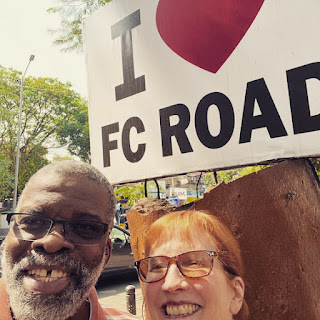
People and Parrots We are here in Pune, India, for my Fulbright Fellowship after a 2-year COVID delay. The Air India flight was as good as a 13-hour flight can be. The transfer in Delhi was a bit stressful as we didn’t know we had to go through Immigration and then come back in through security to board our flight to Pune. Once we arrived at the Pune airport, the hotel driver was right there waiting for us and we made the Ramee Grand Hotel our home for the week. The hotel was quiet and well equipped, but the best parts were the staff and the food. The exemplary staff met our every need, including having the driver take us to an office to get some money changed when we didn’t have success just showing up to a bank. The hotel is a short walk - maybe a kilometer (as it seems everything is just about a kilometer away, even if it isn’t!) from the college. Fergusson College Road (FC Road) is teeming with people, shops, auto-rickshaws, bicycles, cars, cabs, and more people. As in any big city, there were beggars—like NYC there are extremes in India, the poor and the rich cohabit the city. One unique experience was a short, older, Indian woman dressed in a simple saree holding a plate with flowers and colors (maybe for Holi), who walked beside me and then swiped her thumb upward on my forehead…whether in a blessing or a plea for me to purchase something, I’ll never know.
We were encouraged and blessed by the warm welcome we received at Fergusson College. A few days after our initial visit I met with students who expressed an interest in my two classes—Creative Writing and Research Methodology (something for the right brain and the left brain!). Then on Wednesday, we moved into our cottage for the duration in a lovely area of Pune, Aundh. The garden, replete with all kinds of birds I hope to soon identify, was the big selling point for me. The green parrot above was one of dozens, I’m not exaggerating, who live in the trees surrounding the Ramee Grand Hotel. When dusk falls, the parrots come out and fly around from treetop to treetop—an amazing sight. I won’t bore you with the numerous forms, FRRO, SIM card, and other technicalities we had to take care of this first week. All in all, it was a good start to our adventure in India. Stay tuned!

Thursday, September 16, 2021

Normalizing Interracial Relationships

 Fiction has many purposes—to entertain, instruct, expand the mind, change perspective, increase empathy, escape, travel, learn history, solve puzzles, learn about ourselves. Please add your own in the comments below - this list is far from exhaustive. I have found all these purposes at play in my own personal and professional reading. I gravitate toward fiction, but also enjoy the occasional memoir, biography, or history.

I recently read We Hope for Better Things, by Erin Bartels. It’s my favorite genre, historical fiction, covering a time and issue I cover in my historical novel Remnant, slavery in the United States. Bartels’ main characters find love across the color line. Interracial relationships are so common in her novel, they are almost expected. As I read through the reviews of We Hope for Better Things, I was struck by the paucity of comments on interracial relationships. One reviewer, Diane McPhail, writes “her striking protagonists, threaded together by unsuspected ties and deeply buried secrets, emerge as women of unusual strength, ability, and courage in the face of racial injustice. . . Each stands defiantly against cultural norms, in community, and in family, in the era in which they live.” McPhail skirts the issue of interracial relationships but doesn’t tackle it head-on. Very few reviewers mention the fact that the three main protagonists, women spanning three centuries, ALL engaged in interracial relationships. Wow! Isn’t that unusual! Or is it? 

Years ago, when I told my sister the plot of my novel Remnant, she pointed out that I had more than one interracial relationship and that stood out to her. At the time I didn’t even realize it! Of course, I knew my characters and I knew the men and women who formed relationships, but it didn’t strike me as odd or unusual that both my protagonists had interracial relationships. Why? Because interracial relationships are not unusual to me. They’re normal! I’m married interracially, and I know many interracial couples—all kinds of wonderful combinations: Black and White; Puerto Rican and biracial; African and Caucasian American; Chinese and Caucasian American; Indian and Caucasian American; Filipino and Italian; Filipino and African American… the list goes on. It feels like the most natural thing in the world to me. People are attracted to each other for many reasons, and race may or may not be a factor.

Wittingly or unwittingly, Bartels normalizes interracial relationships in We Hope for Better Things. I purposely normalize interracial relationships in Remnant. One of the powers of the written word is to change perspective, and I hope our novels change people’s minds about how ‘normal’ or ‘abnormal’ interracial relationships are—I think they’re normal!


Monday, July 26, 2021

Women and Language

I’m “just” saying - qualifiers and seeking approval undermines female speech

As I work on my novel Remnant, I am using the “find/replace” feature in new ways. With different dialects in the novel, including slave dialect, I wanted to make sure all the instances of “just” were written as ‘jes and not ‘jus. So I did a “find” command with “just” and was shocked at what I saw. In my 400+ page manuscript, there were over 250 uses of “just.” Some of them were appropriate, but in many cases, the word was used by female characters and it undermined or undervalued their speech. 

Sometimes “just” can be replaced with “only,” “simply,” “recently,” or “barely.” Often it is not needed at all - similar to “that,” a word I encourage my students to delete whenever possible. We use “just” and other words like it to soften our speech so we don’t seem so demanding. For instance, “can I just have a cup of coffee?” Or “I just need a moment of your time.” 

I noticed this the last few weeks as I watched Jeopardy. This is a generalization, but I noticed it often enough that I bet a study could be done on how men and women use language to ask for categories on Jeopardy. The men often say “mountains, 200” - in other words, they succinctly say what they want using a shortened form of the category and the amount. On the other hand, women often use qualifiers and say “may I have mountains for 200, please?” They are more polite, but they tend to ask permission more instead of stating what they want.

As I reviewed all the instances of the use of “just” in my novel, I had to make decisions about why the character used that word, if it were appropriate, and if I could either delete it or use a synonym. Take this sentence in the novel: “No, just my papa and his sister were kidnapped.” As I read it again, I wondered how I could use “just” to describe something as heinous as a kidnapping into slavery. It seems glaringly inappropriate at a second glance. Or how about this dialogue? “Don’t worry about my hair.  I can just pin it up.  You have a lot to do.” Here the character is meek and apologetic. Does that fit the personality of my character at this point in the novel?

Have you found helpful uses for the “find/replace” feature in MS Word? Let me know about them in the comments. I’m just saying…

Saturday, June 12, 2021

Using color to convey tone: The Things We Do for Love, Kristin Hannah


As I read Kristin Hannah’s new book, I was struck anew by her descriptive writing, but especially her use of color to convey tone. Descriptions of bright colors seemed to leap off the page. Judicious use of color can add pop and sparkle, enhance the mood, reflect emotion, and provide concrete details that help the reader picture a scene.

Here are a few examples.

White and pink are lively, fun, calm colors:

“…wallpapered in roses and white baskets, held twin beds ruffled in pink bedding” (10)

Alliteration accompanies vivid descriptions: 

“…gleaming gold of her hardwood floors…” (16)

“…long ago painted in bright blues and greens and pale pinks to reflect the Victorian fishing village theme” (22)

Gray is often used to create a somber or depressed tone:

“…the Pacific Ocean was a windblown gray sail that stretched to forever…” (22)

“The sky was an ominous gunmetal gray…” (80).

Color can be used to denote changes:

“…those tiny green leaves would curl and blacken…” (4)

“The shingles, once a cedar red, had aged to the color of driftwood, silvery soft. The white trim was barely a contrast at all” (23)

This is a veritable riot of colors, showcasing the personality of Angie’s sister Livvy through her furnishings and fashion:

“Pale blue velvet sofas faced each other, separated by a glossy wood table. The accent chairs were ornately gilt; the fabric was pink and blue flowers. The sculpted carpet was orange” (68). 

“…she looked like a Bic pen in her black silk sheath…” (7) 

 Contrast the first description of Angie’s mother with the subsequent description of her rich boyfriend David’s home:

“She was porcelain pale; blue-black mascara smudged around her eyes. The faintest hint of her once-great beauty remained, like a glimmer of gold trim on a dirty china plate, peeking through” (36).

 “Beautiful, translucent bone china rimmed in gold sat on ivory silk placemats. Gold flatware glinted in the light of a single candle” (64). 

As I revise my historical novel Remnant, I am cognizant of using color to convey mood, emotion, and detail. Here are a few examples. When the main character and her brother are kidnapped in Africa, the mood is solemn, traumatic, and the colors need to reflect and match the mood:

“…the woman tied a dirty gray rag across my mouth and around the back of my head, forcing my tongue to the back of my throat, and then did the same to Ledu…” 

When I visited Magnolia Gardens, a plantation in South Carolina, I was struck by the juxtaposition of beauty and ugliness. Slavery existed in the south in some stunningly beautiful places. I wanted to convey this sense of dissonance in my novel.

                                            Bridge at Magnolia Plantation and Gardens
                                            https://www.scpictureproject.org/charleston-county/magnolia-plantation.html

“I looked back at the pen where men and women were being sold, and ahead to the ocean, swelling in all its glory.  How could this world be so ugly and so beautiful? As the sun began to set over the horizon, we were momentarily stunned at the beauty of it. The reds and yellows were shot through with purples and pinks, painting the sky with uneven swaths of bright color.”

What have you read lately where color was used to great effect? Or, what are you writing now, and how are you incorporating colors in your writing? I look forward to your comments.

Join me at katiesweeting.com for new blog posts and other updates.

Sunday, May 2, 2021

Northanger Abbey: Catherine Morland, an "accidental feminist"

 Last week I had the awesome privilege to teach a class of graduate students at Fergusson College in Pune, India. Although I couldn’t see the 38 students, I could view their names and we could interact. Even though we tested the technology ahead of time, there were still some glitches: I couldn’t access the chat and my PowerPoint presentation didn’t work in full screen. All of us who teach online or remotely know we need to be flexible. So we soldiered on, overcame the technical deficiencies, and had a wonderful class!

Not being able to use the chat turned out to be a blessing. The questions I would have put in the chat I simply asked aloud, and I got great responses from the students. I was a bit surprised to hear several male voices—either there were a lot of males in the class, or they were just more vocal! Either way, I smiled as I listened to apt interpretations of Northanger Abbey from both the males and females.

To begin I covered the genre of the novel—covering aspects like length, plots and sub-plots, complex characters with inner lives, and entertainment value. I did an elevator speech on Jane Austen—that could take several lectures in itself. Then we took a glance at the theories of literary criticism: Formalism, New Historicism, Psychological (Freudian), Feminist, Archetypal/Mythological, Marxist. I tend to take a New Historicist approach, wanting to know as much as possible about the author and the time period in which she wrote.

                                     Catherine Morland, played by Felicity Jones, from the 2007 
                                        production of  Northanger Abbey directed by Jon Jones

Then we spent the second hour of the class discussing Northanger Abbey in some depth. I asked the class, “Is Catherine Morland a feminist?” Catherine is honest, direct, turns down, and accepts marriage proposals; she speaks her mind to her peers, Isabel Thorpe, and her ‘betters,’ General Tilney. But do these qualities make her a feminist? One of the students offered a brilliant answer to the question. She called Catherine Morland an “accidental feminist.” Maybe she didn’t intend to be a feminist or strive to be a feminist, but for her time period, she really was a feminist!

Catherine Morland was not a feminist in terms of the modern definition of belief and advocacy for equal social, political, and economic status. And she might not have met the standards of Mary Wollstonecraft, though both would agree that a wife is more of a ‘companion’ than an ornament or servant.

What do you think? Was Catherine Morland a feminist? Was she ahead of her time? Please let me know your thoughts by commenting below.

Check out my new website: katiesweeting.com. I'll be discontinuing this blog and blogging from my website in the coming weeks.

Wednesday, February 24, 2021

Historical novel research - Taboo no Longer: Menstruation in 19th Century England

You may wonder why I'm writing a blog on menstruation! Well, I'm revisiting and revising my historical novel Remnant, adding some drama to Joanna's storyline. Joanna Vassa, the daughter of famed abolitionist Olaudah Equiano, died of uterine disease, maybe endometriosis. It's likely she suffered from painful periods and I plan to include this in the novel...hence the research. After spending days on research, it will probably amount to a few paragraphs in the book, but the journey is worth it. 

Joanna came of age during the Regency Era in England, so designated because King George III was mentally incapacitated and his son George took over as Prince Regent from 1811-1830. Following the Regency Era was the Georgian Period, followed by the Victorian Era, from 1837-1901; Queen Victoria was one of England's longest-serving monarchs. My research hit a brick wall when searching for Regency or Georgian information on menstruation, so I had to look back to the Elizabethan Era or ahead to the Victorian Era.

In the Elizabethan Era, theories about menstruation include a necessary balancing of the four humours: pure blood, black bile, yellow bile, and phlegm. A woman's monthly bleeding would return her body to a natural, healthy balance of fluids. Beliefs that menstruating women had magical powers or that menstrual blood could cure diseases abounded. In fact, Roman philosopher Pliny the Elder wrote "that a menstruating woman could stop hail storms and lightning, as well as kill crops" (History). It was common in the Middle Ages for women to simply bleed into their clothes. I really find it hard to picture a woman walking down the street leaving behind a trail of blood!

Middle or Upper-class women were often consigned to bed rest during their monthly cycle in the Victorian Era. Charles Knowlton, who wrote Fruits of Philosophy in 1832, stated that during her menstrual cycle "the woman is said to be unwell, or out of order...dancing in warm rooms, sudden exposure to cold or wet, mental agitations should be avoided as much as possible" (Showalter 84). Men made decisions about what women could or could not do. 

Elaine Showalter points out that "scientific fact and scientific theory were being influenced by the prevailing social or ethical doctrine of women's inferiority...governed by prejudices rather than scientific truth" (Showalter 85). Elizabeth Garrett Anderson, an English physician, pushed back against the theory that women were incapacitated for one week out of every month during their period, and claimed from personal and professional experience that "the extent of female invalidism was greatly exaggerated by male doctors... and that most adult women completely disregard menstruation in relation to their normal activities" (88). 

Victorian women "used outhouses, chamber pots, or a discreet outdoor spot, [women] did not normally wear panties or other clothes that would need to be pulled down" (Freidenfelds). However, during their monthly cycle, women wore some kind of cloth or diaper, often with a belt, a precursor to the first Kotex pads with belts in the 1920s.

I was also curious about what women (and men) called the menstrual cycle in the early 19th century. In the 17th century, they referred to flowers, courses, and terms, as in "she is having her courses." Quite frequently no specific vocabulary would be used at all. Instead, someone might say "she hasn't had those for a while," or they might say she is "in the custom of women" (Reid). 

Interestingly, Natalie Joffe points out that "it was noted that some groups had a rich vocabulary for menstruation, while others had but the scantiest of terms" (Joffe). The Irish have very few words and the French employ a plethora of words, denoting not just their attitude toward menstruation but their attitude toward women's sexual health in general. Words used to denote menstruation often referred either to the monthly frequency-- that time of the month, her time, monthlies-- or the idea that women were not feeling well while menstruating--unwell, the curse. Meigs, writing in 1852, notes that "among us , it is called courses , periods , terms , monthlies , monthly sickness , unwell , times , and a variety of other names , hints , and allusions , that need not be here summed up" (Meigs).

Historical fiction novelists spend weeks, months, or even years conducting research to insure the history is accurate. Finding reliable sources for some topics is quite difficult, as I discovered when simply trying to find out what they called a "period" in 1807!

______________________________________________________

Bibliography

Freidenfelds, Lara. "Period Drama: That Time of the Month in Victorian America." National 

Museum of Civil War Medicine. 12 February 2017 https://www.civilwarmed.org/menstruating/

Hindson, Bethan. “Attitudes Towards Menstruation and Menstrual Blood in Elizabethan England.” Journal of Social History, vol. 43, no. 1, Fall 2009, pp. 89–114. EBSCOhost, doi:10.1353/jsh.0.0246.

Ives, Susanna. "Tidbits on Mid-Victorian Era Menstrual Hygiene." http://susannaives.com/wordpress/2015/09/tidbits-on-mid-victorian-era-menstrual-hygiene/
Joffe, Natalie F. "The Vernacular of Menstruation," WORD, 4:3, 181-186, DOI: 10.1080/00437956.1948.11659341

Meigs, Charles Delucena. Obstetrics: The Science and the Art.

Read, Dr. Sara. Menstruation and the Female Body in Early Modern England. Palgrave Macmillan, 2013.

Showalter, Elaine, and English Showalter. “Victorian Women and Menstruation.” Victorian Studies, vol.14, no. 1, 1970, pp. 83–89. JSTOR, www.jstor.org/stable/3826408. Accessed 22 Feb. 2021.

The History of Periods: How Women Have Dealt With Menstruation Through the Ages. https://www.knixteen.com/blogs/the-rag/the-history-of-periods. 23 May 2018