Tuesday, July 12, 2022

Jugaad - during my Fulbright in India


At our second meeting of the Jane Austen Book Club (JABC) I wanted to make scones. I thought the British tradition might transport us to Jane Austen’s time. However, I lacked several ingredients and tools needed to make scones. I don’t have an oven; I couldn’t get white flour, and vanilla extract is prohibitively expensive. So I “made do.” I’ve been doing that a lot during the past two months in India. One of the young ladies in the JABC informed me that “making do” is a very Indian proposition — so much so that there is a word for it— jugaad. Jugaad means making do. Jugaad is making something using what is available. Jugaad, or improvising, is a very common Indian practice. Instead of using an oven, I used the microwave/convection oven. Instead of using white flour, I used almond flour. I omitted the vanilla extract. Instead of zesting the orange peel, I used a knife to cut it into tiny pieces. The cranberry orange scones were not quite as big and fluffy as usual, but they were tasty! Jugaad!

In other areas of my life I have used jugaad— here are just a few. In the kitchen: At home, I have a large variety of implements and utensils (grater, peeler, zester); a variety of knives; many pots, pans, and baking sheets; a toaster, blender, and mixer; and all kinds of spatulas and large spoons. Here I have one small knife; forks, spoons, and knives; one pot, one pan, and a bowl. That’s it! We make toast in the pan—it’s convenient to fry an egg on one side and toast bread on the other; if you don’t have a spatula, use a common table knife; get some exercise and beat your batter or cream by hand. I can make simple meals with what I have.


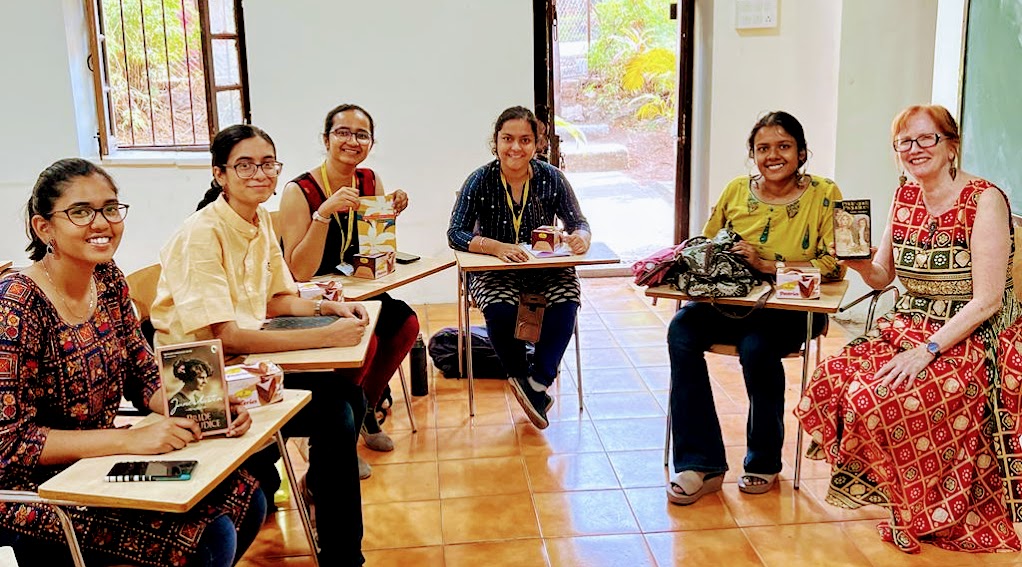
Technology: One classroom I use has no technology— no computer or projector. The other room, pictured at right, has computers that sometimes work.

There are ways to teach with technology without having technology in the classroom. No, that’s not antithetical. To use a PowerPoint in the classroom, I use Nearpod. It’s an app where students can view PowerPoints on their phones. They can also take polls (PollEverywhere) and quizzes (Kahoot or Socrative) on their phones, and contribute to word clouds (Answer Garden). Even if the power goes out, which it frequently does but usually not for very long, we can still access our phones. Once when I was teaching Research Methodology the power went out for about 45 minutes. I opened the doors to let the breeze cool us off, as the ceiling fans had stilled. My laptop still had power and I was connected to WiFi, so I held up my laptop and continued to teach. We don’t let small inconveniences like a lack of power stop us from teaching and learning!

My husband Bill and I have learned to practice jugaad in several other ways while living here in India (or just a simpler lifestyle): we wash our clothes by hand in a bucket; my hair gets a blow-dry on the rickshaw ride to school; if the power goes out our phones have a flashlight; paper clips can be used as screwdrivers; cold showers are refreshing; if you run out of bug spray, invite some lizards in, or turn up the AC and dive under the covers; if you can’t make copies of documents….. no, I draw the line there. I’m not going back to the days of monks and copying a document by hand 20 times! If all else fails, take a nap! Please add your own jugaad fixes in the comments below!

Thursday, May 5, 2022

Cats on a Hot Tin Roof


Cats on a hot tin roof; 

This is not a spoof. 

I caught them in the act, 

plodding without tact; 

no quiet creeping fog,

but sounds like a dropped log 

wake me at 6 a.m. 

an alarm I condemn.


Three small, thin, wastrel cats  

sleep on our roof on mats,

but before the sun rises

they start their surprises—

jumping, falling, leaping,

above our bodies sleeping;

our rest is interrupted;

our sleep is cut, abrupted.


After the cats, the birds

wake us without words—

the cuckoos call coo-ee

it’s morning, don’t you see?

Crows join the morning chorus,

caw, caw, caw —please join us—

reminds me of Dad’s ritual

in feeding crows was punctual.


If birds do not interrupt

my sleep, nor dreams disrupt,

dogs will inevitably

bark most capably.

It seems to be my fate

to not sleep in till 8.


If Indian sounds in the morn

from our lives were shorn—

would we regret the loss,

or then become less cross?

Would extra hours of sleep

make up for loss of peeps?

I cannot make a choice

to deprive of a voice,

animals, and birds that sing

a welcome to morning bring.


Vikram Seth’s Golden Gate inspired me to write in verse rather than prose for this blog post.

Tuesday, April 12, 2022

Saree day and cultural appreciation (not appropriation)

      Thursday was Saree Day at Fergusson College. I draped my fancier saree and took an Uber Auto rickshaw to the college. The female students normally dressed in kurtas and leggings, or salwar kameez, or t-shirts and jeans, were now decked out in vibrant, sparkling sarees—shocking pink to pale purple to crimson red to cobalt blue (most a combination of the above!). The young ladies dazzled in their finery. Long, dangling gold earrings, elaborate nose rings, and necklaces gracing the forehead (bindi) completed the look. Bindis dotted the spot between eyebrows recently plucked or threaded. Young men and women took pictures outside—in pairs, groups, or alone. It looked like young people preparing to go to prom, but in India, there was no prom. There was, however, a raucous, exuberant dance party outside the following day.
      I admired all the finely-dressed students and joined in the picture-taking. Some of my students wanted to add a bindi to my forehead—when I asked what it signified I heard a variety of responses: wisdom; married status; belonging… to a husband, or to God; fashion statement; status alert; religious devotion. All my students were thrilled to see me in a saree, and everyone who talked to me had the same query: “did you drape it yourself?” asked one. “Did you tie it on by yourself?” asked the general. They were more impressed I could put it on properly than by the fact I wanted to wear it. And I did want to wear it. I enjoy wearing sarees—they make me feel beautiful! The housekeeper/cook at our Airbnb, in her limited but expressive English, pronounced me, “Indian! Nice.” 
      I ask myself, where is the line between cultural appreciation and cultural appropriation. All of my sarees were gifted to me by Indian girlfriends. All my students and colleagues smiled when they saw me in a saree. I appreciate many aspects of Indian culture, clothing, and food are at the top of the list. Cultural appropriation is “the unacknowledged or inappropriate adoption of the customs, practices, ideas, etc. of one people or society by members of another and typically more dominant people or society” (Wikipedia). Using this definition as a guide, I don’t think my use of Indian attire is appropriation. I hope my appreciation and acknowledgment of Indian beauty and customs are evident in my behavior and attitude. I was hesitant to wear the bindi as I somehow felt that was crossing a line from appreciation to appropriation—as maybe a nose ring would be for me. But where is the line, and how do we know if we’ve crossed it? I’d love to hear your thoughts. Please comment below.

Sunday, March 20, 2022

People and Parrots

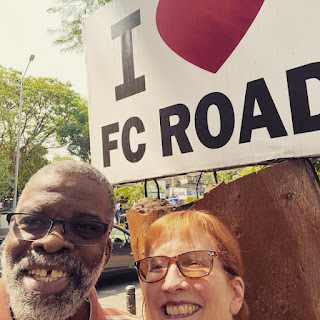
People and Parrots We are here in Pune, India, for my Fulbright Fellowship after a 2-year COVID delay. The Air India flight was as good as a 13-hour flight can be. The transfer in Delhi was a bit stressful as we didn’t know we had to go through Immigration and then come back in through security to board our flight to Pune. Once we arrived at the Pune airport, the hotel driver was right there waiting for us and we made the Ramee Grand Hotel our home for the week. The hotel was quiet and well equipped, but the best parts were the staff and the food. The exemplary staff met our every need, including having the driver take us to an office to get some money changed when we didn’t have success just showing up to a bank. The hotel is a short walk - maybe a kilometer (as it seems everything is just about a kilometer away, even if it isn’t!) from the college. Fergusson College Road (FC Road) is teeming with people, shops, auto-rickshaws, bicycles, cars, cabs, and more people. As in any big city, there were beggars—like NYC there are extremes in India, the poor and the rich cohabit the city. One unique experience was a short, older, Indian woman dressed in a simple saree holding a plate with flowers and colors (maybe for Holi), who walked beside me and then swiped her thumb upward on my forehead…whether in a blessing or a plea for me to purchase something, I’ll never know.
We were encouraged and blessed by the warm welcome we received at Fergusson College. A few days after our initial visit I met with students who expressed an interest in my two classes—Creative Writing and Research Methodology (something for the right brain and the left brain!). Then on Wednesday, we moved into our cottage for the duration in a lovely area of Pune, Aundh. The garden, replete with all kinds of birds I hope to soon identify, was the big selling point for me. The green parrot above was one of dozens, I’m not exaggerating, who live in the trees surrounding the Ramee Grand Hotel. When dusk falls, the parrots come out and fly around from treetop to treetop—an amazing sight. I won’t bore you with the numerous forms, FRRO, SIM card, and other technicalities we had to take care of this first week. All in all, it was a good start to our adventure in India. Stay tuned!

Thursday, September 16, 2021

Normalizing Interracial Relationships

 Fiction has many purposes—to entertain, instruct, expand the mind, change perspective, increase empathy, escape, travel, learn history, solve puzzles, learn about ourselves. Please add your own in the comments below - this list is far from exhaustive. I have found all these purposes at play in my own personal and professional reading. I gravitate toward fiction, but also enjoy the occasional memoir, biography, or history.

I recently read We Hope for Better Things, by Erin Bartels. It’s my favorite genre, historical fiction, covering a time and issue I cover in my historical novel Remnant, slavery in the United States. Bartels’ main characters find love across the color line. Interracial relationships are so common in her novel, they are almost expected. As I read through the reviews of We Hope for Better Things, I was struck by the paucity of comments on interracial relationships. One reviewer, Diane McPhail, writes “her striking protagonists, threaded together by unsuspected ties and deeply buried secrets, emerge as women of unusual strength, ability, and courage in the face of racial injustice. . . Each stands defiantly against cultural norms, in community, and in family, in the era in which they live.” McPhail skirts the issue of interracial relationships but doesn’t tackle it head-on. Very few reviewers mention the fact that the three main protagonists, women spanning three centuries, ALL engaged in interracial relationships. Wow! Isn’t that unusual! Or is it? 

Years ago, when I told my sister the plot of my novel Remnant, she pointed out that I had more than one interracial relationship and that stood out to her. At the time I didn’t even realize it! Of course, I knew my characters and I knew the men and women who formed relationships, but it didn’t strike me as odd or unusual that both my protagonists had interracial relationships. Why? Because interracial relationships are not unusual to me. They’re normal! I’m married interracially, and I know many interracial couples—all kinds of wonderful combinations: Black and White; Puerto Rican and biracial; African and Caucasian American; Chinese and Caucasian American; Indian and Caucasian American; Filipino and Italian; Filipino and African American… the list goes on. It feels like the most natural thing in the world to me. People are attracted to each other for many reasons, and race may or may not be a factor.

Wittingly or unwittingly, Bartels normalizes interracial relationships in We Hope for Better Things. I purposely normalize interracial relationships in Remnant. One of the powers of the written word is to change perspective, and I hope our novels change people’s minds about how ‘normal’ or ‘abnormal’ interracial relationships are—I think they’re normal!


Monday, July 26, 2021

Women and Language

I’m “just” saying - qualifiers and seeking approval undermines female speech

As I work on my novel Remnant, I am using the “find/replace” feature in new ways. With different dialects in the novel, including slave dialect, I wanted to make sure all the instances of “just” were written as ‘jes and not ‘jus. So I did a “find” command with “just” and was shocked at what I saw. In my 400+ page manuscript, there were over 250 uses of “just.” Some of them were appropriate, but in many cases, the word was used by female characters and it undermined or undervalued their speech. 

Sometimes “just” can be replaced with “only,” “simply,” “recently,” or “barely.” Often it is not needed at all - similar to “that,” a word I encourage my students to delete whenever possible. We use “just” and other words like it to soften our speech so we don’t seem so demanding. For instance, “can I just have a cup of coffee?” Or “I just need a moment of your time.” 

I noticed this the last few weeks as I watched Jeopardy. This is a generalization, but I noticed it often enough that I bet a study could be done on how men and women use language to ask for categories on Jeopardy. The men often say “mountains, 200” - in other words, they succinctly say what they want using a shortened form of the category and the amount. On the other hand, women often use qualifiers and say “may I have mountains for 200, please?” They are more polite, but they tend to ask permission more instead of stating what they want.

As I reviewed all the instances of the use of “just” in my novel, I had to make decisions about why the character used that word, if it were appropriate, and if I could either delete it or use a synonym. Take this sentence in the novel: “No, just my papa and his sister were kidnapped.” As I read it again, I wondered how I could use “just” to describe something as heinous as a kidnapping into slavery. It seems glaringly inappropriate at a second glance. Or how about this dialogue? “Don’t worry about my hair.  I can just pin it up.  You have a lot to do.” Here the character is meek and apologetic. Does that fit the personality of my character at this point in the novel?

Have you found helpful uses for the “find/replace” feature in MS Word? Let me know about them in the comments. I’m just saying…

Saturday, June 12, 2021

Using color to convey tone: The Things We Do for Love, Kristin Hannah


As I read Kristin Hannah’s new book, I was struck anew by her descriptive writing, but especially her use of color to convey tone. Descriptions of bright colors seemed to leap off the page. Judicious use of color can add pop and sparkle, enhance the mood, reflect emotion, and provide concrete details that help the reader picture a scene.

Here are a few examples.

White and pink are lively, fun, calm colors:

“…wallpapered in roses and white baskets, held twin beds ruffled in pink bedding” (10)

Alliteration accompanies vivid descriptions: 

“…gleaming gold of her hardwood floors…” (16)

“…long ago painted in bright blues and greens and pale pinks to reflect the Victorian fishing village theme” (22)

Gray is often used to create a somber or depressed tone:

“…the Pacific Ocean was a windblown gray sail that stretched to forever…” (22)

“The sky was an ominous gunmetal gray…” (80).

Color can be used to denote changes:

“…those tiny green leaves would curl and blacken…” (4)

“The shingles, once a cedar red, had aged to the color of driftwood, silvery soft. The white trim was barely a contrast at all” (23)

This is a veritable riot of colors, showcasing the personality of Angie’s sister Livvy through her furnishings and fashion:

“Pale blue velvet sofas faced each other, separated by a glossy wood table. The accent chairs were ornately gilt; the fabric was pink and blue flowers. The sculpted carpet was orange” (68). 

“…she looked like a Bic pen in her black silk sheath…” (7) 

 Contrast the first description of Angie’s mother with the subsequent description of her rich boyfriend David’s home:

“She was porcelain pale; blue-black mascara smudged around her eyes. The faintest hint of her once-great beauty remained, like a glimmer of gold trim on a dirty china plate, peeking through” (36).

 “Beautiful, translucent bone china rimmed in gold sat on ivory silk placemats. Gold flatware glinted in the light of a single candle” (64). 

As I revise my historical novel Remnant, I am cognizant of using color to convey mood, emotion, and detail. Here are a few examples. When the main character and her brother are kidnapped in Africa, the mood is solemn, traumatic, and the colors need to reflect and match the mood:

“…the woman tied a dirty gray rag across my mouth and around the back of my head, forcing my tongue to the back of my throat, and then did the same to Ledu…” 

When I visited Magnolia Gardens, a plantation in South Carolina, I was struck by the juxtaposition of beauty and ugliness. Slavery existed in the south in some stunningly beautiful places. I wanted to convey this sense of dissonance in my novel.

                                            Bridge at Magnolia Plantation and Gardens
                                            https://www.scpictureproject.org/charleston-county/magnolia-plantation.html

“I looked back at the pen where men and women were being sold, and ahead to the ocean, swelling in all its glory.  How could this world be so ugly and so beautiful? As the sun began to set over the horizon, we were momentarily stunned at the beauty of it. The reds and yellows were shot through with purples and pinks, painting the sky with uneven swaths of bright color.”

What have you read lately where color was used to great effect? Or, what are you writing now, and how are you incorporating colors in your writing? I look forward to your comments.

Join me at katiesweeting.com for new blog posts and other updates.