Saturday, November 14, 2020

Where the Crawdads Sing - Paean to the marsh

Don't you hate it when book descriptions are imprecise or inaccurate? I have avoided reading Where the Crawdads Sing because I was told it was mainly about an abusive father. An abusive father plays a role in the book, maybe a pivotal role, but he is not the most important character, and in fact, his part on the book's stage is small.

Order here 
Rather, the book is a love song to the marsh and the Marsh Girl. Delia Owens' lyrical writing about nature reminds me of Tracy Chevalier's At the Edge of the Orchard, or Remarkable Creatures, or Barbara Kingsolver's Flight Behavior or Prodigal Summer. Interestingly, Barbara Kingsolver has a degree in biology and Delia Owens is a zoologist.

The book is about survival - Kya, aka the Marsh Girl, is abandoned by everyone. Her mother leaves, then all her siblings leave, and finally, her abusive father leaves. She lives alone in a shack at the edge of a marsh in North Carolina - alone as in there were no other humans around. With only one day of formal schooling, and no adults to guide her, she survives. When she becomes a young woman, two men come into and out of her life, and she survives their betrayal, too.

Kya's best friends are the seagulls, the great blue heron (one of my favorite birds), and Cooper's Hawk. Owens describes the great blue heron as "the color of gray mist reflecting in blue water" who walks slowly "like a predacious bridesmaid" (Owens 109). Kya is so intimately attuned to the creatures who inhabit the marsh, she takes on some of their characteristics (read the book to find out what I mean). Kya observes the birds, insects, amphibians, and sea creatures and even mimics some of their behavior. Owens' writing almost has me scratching imaginary mosquito bites and feeling the cool mud on my feet -- it's that descriptive and engaging.

Like the best writers, her analogies and descriptions are original, yet with a veracity that makes them feel obvious. She describes the nearby town as "quite literally a backwater town, bits scattered here and there among the estuaries and reeds like an egret's nest flung by the wind" (Owens 32). And her analogies, similes, and metaphors reflect the natural world of the novel, so Kya is depicted as "trying to disappear like a bark beetle blending into the furrowed trunk of an oak" (Owens 45).

When her only real friend, Tate, teaches her to read, she reads this line: "there are some who can live without wild things, and some who cannot" (Owens 125). Kya exclaims, "I wadn't aware that words could hold so much. I didn't know a sentence could be so full" (Owens 125). Indeed, I feel like Kya when I read the book - who knew sentences could be so full!

There is a plot, and it has enough twists and turns to keep the reader engaged. But the plot is not what made me love this book. The descriptions of the birds and Kya's relationship to the birds, how she crafts a life for herself, albeit lonely, and how she survives kept me riveted.

Have you read Where the Crawdads Sing? Did you love it as much as I do?!

___________________________________________________________________________

Owens, Delia. Where the Crawdads Sing. G.P. Putnam's Sons, 2018.

Friday, November 6, 2020

A Community of the Curious - Writing and researching historical fiction

 I love research! My students question my sanity, but honestly one of the parts of writing historical fiction I love the best is the research--so much so that I need to forcibly stop myself from continuing to research and start writing my novel. I'm revisiting and revising my historical novel about the daughter (Joanna Vassa) and sister (name unknown) of Olaudah Equiano. In the process of conducting research, I came across three scholars/historians and Equiano aficionados. They are part of a community of the curious about Joanna Vassa. I'm a card-carrying member now, too.

Dr. Angelina Osborne's research uncovered documents about Joanna Vassa and information about her life, which she published in a book entitled Equiano's Daughter, The Life and Times of Joanna Vassa. Momentum Arts in Cambridge published the book as part of the Untold Stories Arts and Heritage Project designed to highlight the lives of Cambridgeshire's Black and Minority Ethnic people. Nine years ago I undertook a pilgrimage to England to visit the sites where Equiano lived and wrote, Joanna's grave, The Congregational Church in Clavering where her husband was minister, and William Wilberforce's museum in Hull. 

Dr. Vincent Carretta is another member of the community of the curious. His research led him to write a seminal biography of Equiano, Equiano the African: Biography of a Self-Made Man

Arthur Torrington, CBE, is a Guyanese-born community advocate and historian who co-founded the Equiano Society in London in 1996. He personally took me on a tour of the spots in London where Equiano is known to have lived and worked and brought me to Joanna Vassa's gravesite in Abney Park Cemetery. The Equiano Society recently hosted a Zoom event on Joanna Vassa, and Dr. Vin Carretta was one of the speakers.

The community of the curious about Equiano, his life, and his family continues to grow. I am honored and delighted to be part of this particular community of the curious about Joanna Vassa.

What kinds of wonderful people have come into your life through your research?


Saturday, October 31, 2020

Centering the marginalized ... in fiction


According to Merriam-Webster.com, marginalized means "relegated to a marginal position within a society or group."

"Refugees are the world's quintessentially marginalized population: They are by definition located at the edge, beyond boundaries, on the outside."    — Tamar Mayer"… the domination and oppression of women and other marginalized groups within patriarchal culture."    — Susan M. Squier
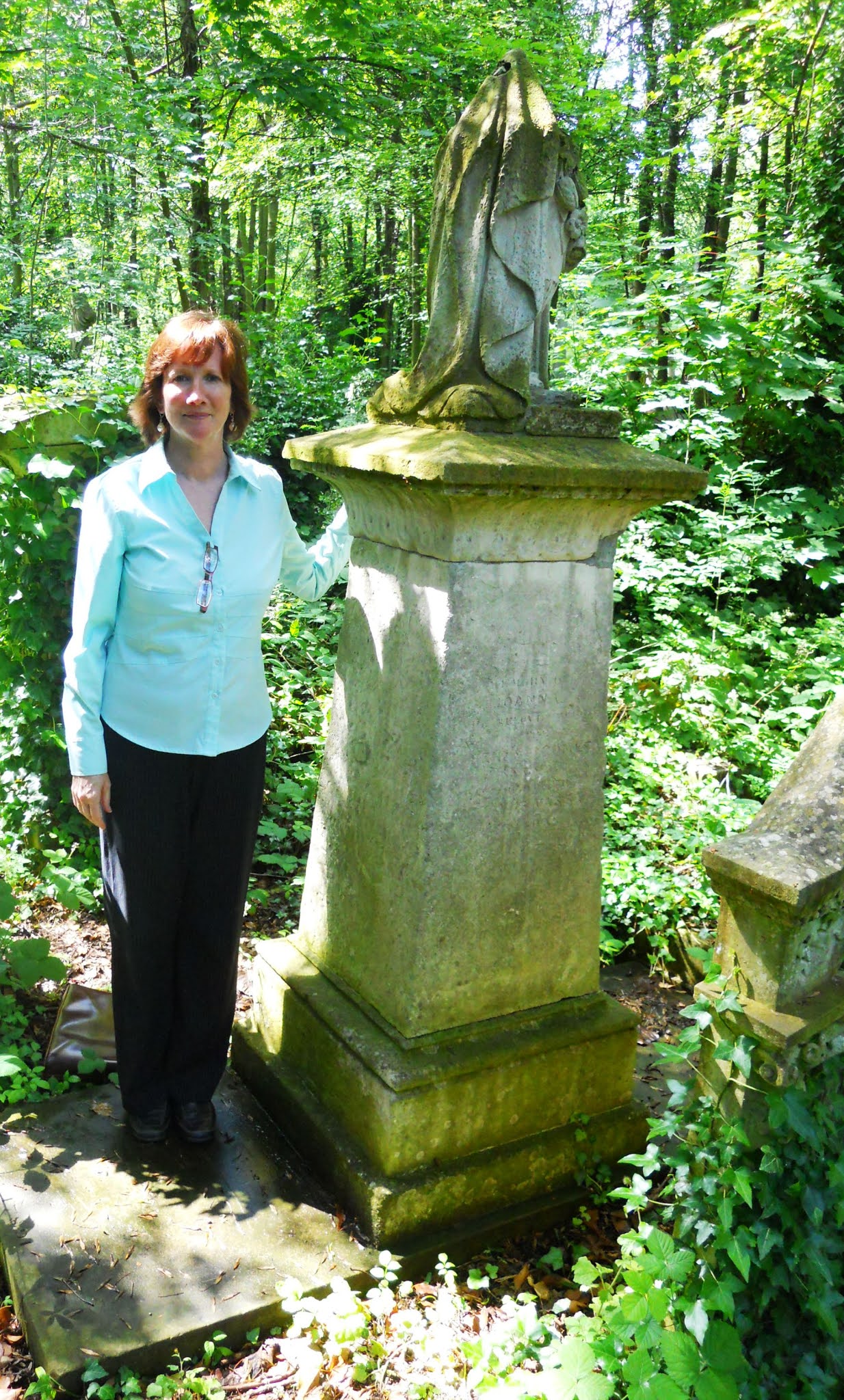
Katie at Joanna Vassa's grave
Joanna Vassa's grave at
Abney Park Cemetery
Marginalized - the first image that comes to mind is a sheet of paper with margins. The margins are purposely blank. The important information is inside the margins. But what does it mean to be marginalized? Society deems certain people, certain groups, usually the oppressed, unfortunate, those struggling for equity and opportunity, and often people outside the bounds of "the norm" -- marginalized.
Who says? Should we accept this relegation to the margins? No! I say let's shift our perspective. Maybe those who have been shuffled off to the margins should be in the center. And even more radical... maybe those consigning people to the margins should be marginalized themselves!Who is marginalized in American society today? Those who don't have a home or a job or hearing or vision or mobility -- they are identified by what they do not have rather than what they do have. Those who occupy an extreme... too dark, too small, too big, too flamboyant, too religious, too political. I've been thinking about the issue of marginalization in relation to the two novels I have written. My first novel, Remnant, a historical novel about the daughter (Joanna Vassa) and sister of Olaudah Equiano. Equiano wrote and self-published his autobiography in 1789 and became the richest African living in England in his day. He married a white woman, Susannah Cullen, and they had two daughters. By 1797 Equiano, also known as Gustavas Vassa, Susannah, and their firstborn daughter Anna Maria had all died, leaving Joanna Vassa a bi-racial two-year-old orphaned. Joanna could be the poster child for a definition of "marginalized" (except for the fact that her family had money and she inherited a tidy sum of £950 when she turned 21). Even the grave of Joanna Vassa was marginalized until Prof. Vincent Carretta discovered it covered in weeds and lying on its side, and brought it to the loving attention of the Abney Park Cemetery staff. He centered her grave. Additionally, Equiano's final resting place was unknown until recently, when Prof. Carretta aided by Equiano Society associate David Gleave found this record in church archives: “6 [April 1797] Gustus Vasa, 52 years, St Mary Le bone.” Equiano is buried in the cemetery next to the former Whitefield’s Tabernacle in Tottenham Court Road (currently the American International Church). Equiano's gravesite location has been centered.Susannah Cullen married Olaudah Equiano - interracial couple #1. Joanna Vassa marries Henry Bromley - interracial couple #2 (these are both historical). Olu (Equiano's sister) marries Teddy - interracial couple #3 (fictional). I'm moving the marginalized (interracial couples) to the center. I'm centering the marginalized in my writing.In my second, contemporary novel, Expecting, the main characteMichaela is traumatized when her mother dies in childbirth, leaving her with a fear of childbirth and determination to become an obstetrician, and preventing her from accepting Victor’s advances…the Deaf man with whom she has fallen in love. My Deaf characters in the novel are in the center of the action, not on the margins. In Expecting, it is normal to be Deaf. I center the marginalized.How do you "center the marginalized" in your writing?

Saturday, October 24, 2020

A Long Petal of the Sea : Why I love historical fiction

 “One of the most richly imagined portrayals of the Spanish Civil War to date, and one of the strongest and most affecting works in [Isabel Allende’s] long career.”—The New York Times Book Review


I'm a big fan of historical fiction. It's my favorite genre. A Long Petal of the Sea has all the elements I love in historical fiction: a good story, well told, set in a historical time and place, with both historical and fictional characters with whom I would love to sit down and have a cup of tea!

A Long Petal of the Sea covers the mid-1930s in Spain, to the 40s-90s in Chile (with brief stops in Spain, the U.S., and Venezuela). If you had asked me anything about the Spanish Civil War before I read this book, I would have a blank look on my face. Whether I ever learned about it (doubtful) or have just forgotten (possible) I could not have related any details whatsoever. Having lived through Allende's fictional retelling, I can now almost picture the war between the Catalonians and the Fascists - with Franco defeating the indefatigable Republican Spaniards. If I want the facts of the Spanish Civil War, I can read a book, or an essay (or Wikipedia!). I will learn about the two sides, the Republicans versus and Nationalists, with "communists" against "Christians" the rallying cry. But if I want to get a sense of history, and engage my senses, I read historical fiction. Through Allende's masterful writing I can smell the fires, feel the fear, cringe at the deprivation and cruelty, and see the destroyed city of Barcelona. 

The book is also a paean to Pablo Neruda, Chilean poet and diplomat. Neruda transported over 2,000 Spanish refugees living in sub-human conditions in concentration camps in France, having fled at the end of the Spanish Civil War, in a ship called the Winnipeg to their new home in Chile. The title comes from Neruda's poetic description of the country of Chile.

For more on this fascinating moment in history, read this: 

https://socialistaction.org/2019/09/25/the-ss-winnipeg-pablo-neruda-and-a-long-petal-of-the-sea/

It strikes me that this book is particularly apt in our present day when fascism and nationalism are on the rise in many countries, and the lines that so starkly divide us get wider every day, becoming more like chasms than lines. 

"Those who cannot remember the past are condemned to repeat it." (George Santayana, Spanish-American philosopher, poet, and novelist). 


Wednesday, September 2, 2020

Gilgamesh - the first "bromance"

 The first day of school - how different it looks in the midst of the COVID 19 pandemic. This is what my first day of school looks like today. 


I'll be teaching all my classes either fully online, or remotely: Speech, Composition 1, Religions of the West, and World Literature to 1650. Yep - four preps. Don't tell my students, but I'm most looking forward to World Literature to 1650.

I designed two World Literature classes over 10 years ago, and have taught both of them multiple times. If you look back in this blog to 2012 you'll see a blog on Gilgamesh. For the past few years, I have taught British Literature, which is great fun, but I'm happy to be back with my old pals Gilgamesh and Enkidu!

Gilgamesh is the first extant literature, written initially in Sumerian as poetry in 2100 B.C.E., and adapted in Babylonian a few hundred years later. It was very popular during its time, but disappeared sometime in the 7th century B.C.E. If not for an English explorer, Austen Henry Layard, digging up the tablets in the 1850s, and the discovery by George Smith at the British Museum in London that the epic contained a flood account similar to the biblical flood, Gilgamesh may have remained in obscurity. Thank you, gentlemen!

What makes ancient literature so relatable, so endearing, so indestructible? The tropes in ancient literature are echoed in modern-day society. Those age-old themes of man against man, man against himself, man against God/gods, and the quest for immortality, a legacy, a place in history... these are not just ancient. They are very modern. Lin-Manuel Miranda understood this when he wrote the songs to the hit musical Hamilton. Alexander Hamilton sought to make a difference, to be remembered, to live on in his words. He fought against men, against God, and against his own baser instincts. His story is popular today because we can relate. He had his band of close friends - John Laurens, the Marquis de Lafayette, and Hercules Mulligan. Some of the content of the letters between John Laurens and Alexander Hamilton may portend a homoerotic relationship. This is also the case in Gilgamesh! 

Gilgamesh and Enkidu - what can I say. They are a mismatched pair, for certain. One is the urban, urbane male. Gilgamesh does have a few, shall we say, character flaws. He sleeps with all the women of Uruk before their husbands can and drafts all the young men into the army. The people complain to the gods, so they create a "companion" for Gilgamesh -- enter Enkidu. "To his stormy heart, let that one be equal" (Foster 22). 

Gilgamesh and Enkidu have the first "bromance" in literature! Gilgamesh's mother Ninsun tells him his dream about Enkidu means he "will fall in love with him and caress him like a woman" (Foster 29). After Gilgamesh and Enkidu meet, they engage in a fierce wrestling match. My male students tell me many of their friendships started as a fight or a conflict! After Gilgamesh prevailed "they kissed each other and made friends" (Foster 31). Keep in mind, in that culture men kissed as a sign of friendship; they still do in many Middle Eastern countries. Were Gilgamesh and Enkidu friends, or lovers? There are arguments to be made on both sides.

In my next post, we'll look at Gilgamesh's quest for immortality.

_________________________________________________________________________________
Foster, Benjamin, translater. GilgameshThe Norton Anthology of World Literature, Shorter Fourth 
       Edition, edited by Martin Puchner, et al. WW Norton & Company, 2019.

Tuesday, August 4, 2020

How to raise an Anti-racist

In step with my theme Writing as Allyship, I wrote this OpEd and sent it off to a few papers - the LA Times, the NY Times, the Wall Street Journal. They did not choose to publish it, so I'm sharing it here.

“In a racist society it is not enough to be non-racist. We must be anti-racist.” Angela Davis

I grew up in the white suburbs of Los Angeles in the 1960s and 70s, or as my dad liked to say, “the relatively smog-free western end of the San Fernando Valley.” I was a Valley Girl, for sure. I might have grown up racist if I didn’t have Richard and Claire O’Connell as parents. 

Formative years
Our family of five lived in Sepulveda and both my parents were college professors—Dad taught psychology at Cal State Northridge and Mom taught English at Santa Monica College. They were card-carrying members of the NAACP and the Fair Housing Council. They wanted Black neighbors (didn’t happen until the 90s). Mom was active in the League of Women Voters and my family espoused liberal, democratic values of equity and inclusion. I was raised in a home, that great incubator for values, promoting the value of Black rights, Black leaders, Black neighbors.

Sepulveda, largely White and Mexican, faced its own issues of racism. The western part of Sepulveda separated from the predominantly Mexican eastern part by renaming itself North Hills. Ironically, “six months after residents of part of Sepulveda changed their region’s name to North Hills--to escape the stigma of crime and seediness they said had become attached to the name--the community they fled rejoined them . . . What remained of Sepulveda will now be named North Hills too…” (Jim Herron Zamora 22 Nov. 1991, LA Times). 

First Black friends
So I grew up in a White suburb where mistrust of Blacks and Latinos was common. While I don’t remember ever having a “talk” about race or racism, my parents embraced people from all backgrounds and races. But they didn’t just model inclusivity; they were intentional. My mom often started up conversations with strangers, so while checking out at Von’s Grocery Store one day, she chatted up the young Black man bagging her groceries. After talking with Lewis several times, Mom invited him over for dinner. He eventually became a lifelong family friend, and I most recently saw him at my mom’s memorial service in 2016. I cannot overestimate Lewis’ influence on me as a young White girl in a completely White neighborhood. He is funny, sweet, kind, and a real storyteller—my positive first introduction to Black men. 

It wasn’t until Cal State Northridge in 1977, that I had my first close Black girlfriend. Lydia was a classmate who lived in Watts. We became friends--she visited my house in the Valley, and I visited her house and church in Watts. Her single mom was raising several girls, some of whom had children of their own. Watts was a world away from where I lived in Sepulveda. Watts was predominantly Black—parents worked mainly in service industries. Lydia’s mom worked as a janitor in a hospital. Twelve years before I met Lydia, Watts erupted in the riots of 1965, precipitated by the treatment of stepbrothers Marquette and Ronald Frye by White Highway Patrolmen and police officers. A gathering crowd and the brute force police exerted exacerbated the tense standoff and riots ensued. Now 55 years later, America is still dealing with the same issues. My friendship with Lewis and Lydia opened my eyes to the history of trauma and systemic racism faced by Black Americans every day. 

My husband and sons 
In 1979 I spent a summer in Kenya, East Africa, on a short-term mission trip. Among the 30 of us from the U.S, Bill Sweeting was the only African American. I was attracted to his gregarious smile and raucous laughter. We became better acquainted over the summer and upon our return to NYC, Bill invited me to stay for a few days to see the sights and meet some of his family. Four months later he flew out to LA to meet my parents—guess who’s coming to dinner!

I moved to New York in 1980 after I graduated from college, and Bill and I married in 1983. By 1999 we had a teen and pre-teen son, so when Amadou Diallo was shot 41 times and killed in 1999 by four white police officers when he reached for his identification, we did have “the talk” with our sons—the talk about what a young Black man should do when approached by a police officer.

Twenty-one years later America is still facing its own racism—both individual and systemic. I will not attempt to posit a solution for systemic racism. I do, however, firmly believe that on an individual level, it is not enough to do nothing. It is not enough to not pass on racism to our children. It is not even enough to model good anti-racist behavior. We must actively, purposefully, consistently teach our children to be anti-racist. It starts with us, the parents. If you’re White, do you have a Black friend? Not an acquaintance, colleague, or neighbor—a real friend. If not, start there. 

Thursday, July 30, 2020

Writing as #Allyship


Summer 2020 -- our country is facing, again, the reality of racism people of color deal with on a daily basis. Precipitated by the murder of George Floyd by a white police officer in Minneapolis, peaceful protests are cropping up in every state. The college at which I teach, Hudson County Community College, has responded to the protests by offering several online programs/webinars/panels. Recently I was on a panel on Allyship. "An ‘ally’ is someone who has privilege, but chooses to stand for and with marginalized communities* by taking tangible, ongoing actions to dismantle systems of oppression. *‘Marginalized communities’ are those who are targeted by oppression, including but not limited to: people of color, Muslims, immigrants, refugees, LGBTQ people, women and people with disabilities." http://www.ywcahbg.org/

Here is one list of some of the main tenets of allyship: 
  1. Listen
  2. Get educated
  3. Get involved
  4. Show up
  5. Speak up
  6. Intervene
  7. Welcome discomfort
  8. Learn from your mistakes
  9. Stay engaged
  10. Donate
I'd like to add one to the list--writing. 

Think of all the things you write, all the audiences you write for, and the ways you engage in discussions with others online. If you're engaged in social media, you probably read posts on Twitter, Instagram, or Facebook. If you see a post that astonishes, educates, or surprises you, there is a good chance you will re-tweet, or re-post. If you're concerned with social justice, you might retweet a post calling for better oversight of police officers, or not cutting programs for the poor, or not stripping away the protection of the Voting Rights Act. Those re-tweets and re-posts are an act of allyship. Anyone can be an ally.

Writing as allyship isn't limited to social media. Think about the creative writing you engage in. Do you write poetry? I'd be willing to bet some of your poems have a message, and you have demonstrated allyship. Do you write short stories or novels? Have you embodied allyship in the characterization or the plot?

As I pondered this concept of allyship and writing, I thought about the two novels I have written and realized the novels themselves are a form of allyship! Remnant, my first novel, is about the daughter and sister of Olaudah Equiano, a Nigerian who was captured in 1754 and wrote the first slave narrative, The Interesting Narrative of the Life of Olaudah Equiano. Drawing attention to historical slaves and descendants of slaves, personalizing them, is one way to enliven history, educate readers while entertaining them, and writing as an ally to the Black community. 

My recent novel features a Deaf family. By portraying Deaf characters as three-dimensional people with loves, preferences, careers, and dreams like anyone else--emphasizing that the Deaf and hearing characters are alike in every way except their degree of hearing, I write as an ally to the Deaf community.

Think about it. How are you an ally in your writing?