Friday, August 18, 2023

Spellbinding biography by a scholar of blazing genius

 Devoney Looser, known for her scholarship on Jane Austen and other ‘strong women’ of the long 18th century, has crafted a detailed and lengthy biography of two fascinating and mostly unknown women - Jane and Anna Maria Porter. While they lived, and afterward, in the late 18th and early-mid 19th century, they were famous novelists. After years of research, combing through stacks and stacks of largely illegible letters, finding and digesting other documents, books, and articles, Looser has compiled not just a biography, but a fascinating tale of two women who were prolific novelists and innovators in the novel form, despite being manipulated by other women, betrayed and led on by many men in their lives, let down by brothers, and at the door of poverty for most of their adult lives.


Who should read this book? Everyone! The book is for all who…

  • love to read about strong women
  • love a twist in the tale
  • love biography that reads like fiction
  • are scholars and professors
  • are librarians
  • are feminists
  • love Jane Austen

Let’s talk about some of the dominant themes of the book. Debt. Almost everyone is in debt and often for most of their adult lives. The two sister novelists, Jane and Maria, are in and out of debt, but mostly in. They write because they love to write, but also because they need to make a living, to pay for their home, the coal that heats it, the clothes they wear, travels to visit friends, their brothers’ debts! Their brothers were often in debt, and sometimes had to leave the country to avoid debtor’s prison. What surprised me was how poorly most people managed their money, especially the men, including Sir Walter Scott! Wow! His writing was phenomenal but his debts were astronomical!

Another consistent theme is manipulation and abuse. Both Jane and Maria are manipulated by men—royalty, actors, brothers. They were led on, mistreated, and even fondled (by women and men!). They ‘hoped’ that a certain personage would leave them a bequest, or a pension, or just loan them some money, and only a few did. The two men who treated them the best, in my opinion, were their two publishers, Longman and Rees. They gave both Jane and Maria advances and went out of their way to be encouraging and helpful, to the extent they could. 

Sex outside of marriage is another theme. Many of the men in the book, and some women, were known for engaging in sex with someone other than their spouses. I learned that adultery was referred to as “criminal conversation” or crim. con. for short, and was punishable with a prison term. For once, only the man was charged (in this case), not the woman, who was cheating on her husband. Royals and commoners alike engaged in extramarital sex, a well-known secret.

“Wow!” I exclaimed aloud as I read page 412. I learned that Harriet Jacobs, whose slave narrative I teach in World Literature 1650-present, raised the child of N.P. Willis (alias Mr. Bruce in Incidents in the Life of a Slave Girl). Nathanial Parker Willis became a close friend and confidante of Jane Porter in her later life. Looser also refers to the Porters sisters’ time with the Volkonsky family and their cousins, the Tolstoys—related to the future novelist (whom I also teach in World Literature!).

One of the reasons I was drawn to and riveted by the book is its time period and setting. My historical novel Remnant is set against the same British backdrop—An Act for the Abolition of the Slave Trade in 1807 and the Slavery Abolition Act in 1833. More good news on Remnant soon!

I could go on, but I’ll stop here so you can go out and buy the book or get it at a local library and start reading! You won’t be disappointed.

Monday, July 31, 2023

Riveting Plots - Part I

I have read two wonderful, unputdownable books recently. They don’t have much in common, other than brilliant female authors, unforgettable characters, and riveting plots! After I finished the second book I reflected on what made these two books great—the plots. Writers and writing teachers have produced thousands of tomes on how to write a good book. But the art and science of teaching creative writing can be traced to Aristotle, who in the fourth century BCE proclaimed a unified plot should include a beginning, middle, and end, cause and effect, and a resolution of the conflict or crisis.  

Madison Smartt Bell, in his book Narrative Design, argues that “to teach creative writing or to be taught it, is a paradox” and “fiction workshops are inherently almost incapable of recognizing success” (Bell 3, 6). However, he states this in a book purporting to teach aspiring writers! Bell believes that “form is where it’s at” (18). He defines form in several ways: “underlying structure”; “form is what reveals the intended total effect”; “the form of a work is its skeleton”; “the pattern of its assembly”; “overall design” (Bell). I’ll look at both plot and form as I examine these books. 

In Someone Else’s Shoes, Jojo Moyes introduces two female characters who appear to be quite different. One is young, beautiful, and wealthy. The other is middle-aged, somewhat frumpy, unappreciated, and harassed at work. They do have one thing in common—the gym. After the older woman accidentally takes the younger woman’s gym bag—the inciting incident—the fun begins.

In a series of just-misses and mishaps, the two women are each embroiled in their own conflicts and dramas. Nisha Cantor’s husband has locked her out and wants to divorce her, leaving Nisha with nothing—no clothes, no money, no ID, and no shoes! Sam’s husband is depressed after the death of his father, and we don’t learn until the end the real reason for the trauma. Nisha doesn’t have a job and Sam is unappreciated and undervalued at work, but when Sam wears the Christian Louboutin red crocodile shoes she discovers in the gym bag she took (thinking it was hers), she experiences a boost of self-confidence and sexiness.

What makes the plot riveting?

  • an unlikely pairing of characters
  • strong minor characters
  • woman power
  • original plot
  • two very different points of view
  • plot twists - what about those shoes is so valuable?
  • character growth - both the main characters and others
  • humor
  • realistic dialogue

Moyes pulls the reader in and makes us care about her characters, as she does brilliantly in all her books. I wanted to get to the end to find out the outcome of the shoes and the characters! I laughed, I cried, I sped up and read faster, I slowed down to catch every word.

The backbone of the book, the underlying structure, in my view, is the ability of women to forge a space for themselves in the world together. Nisha and Sam go from enemies to friends, thrown together by a pair of shoes. Strong women are even stronger together. That’s the backbone of the book.. and I loved it! 


Tuesday, July 12, 2022

Jugaad - during my Fulbright in India


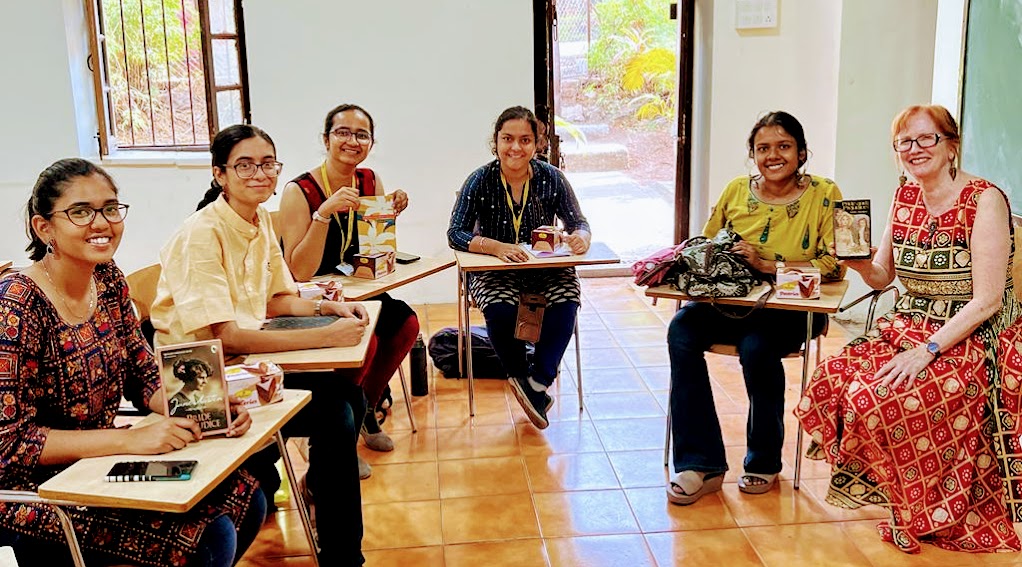
At our second meeting of the Jane Austen Book Club (JABC) I wanted to make scones. I thought the British tradition might transport us to Jane Austen’s time. However, I lacked several ingredients and tools needed to make scones. I don’t have an oven; I couldn’t get white flour, and vanilla extract is prohibitively expensive. So I “made do.” I’ve been doing that a lot during the past two months in India. One of the young ladies in the JABC informed me that “making do” is a very Indian proposition — so much so that there is a word for it— jugaad. Jugaad means making do. Jugaad is making something using what is available. Jugaad, or improvising, is a very common Indian practice. Instead of using an oven, I used the microwave/convection oven. Instead of using white flour, I used almond flour. I omitted the vanilla extract. Instead of zesting the orange peel, I used a knife to cut it into tiny pieces. The cranberry orange scones were not quite as big and fluffy as usual, but they were tasty! Jugaad!

In other areas of my life I have used jugaad— here are just a few. In the kitchen: At home, I have a large variety of implements and utensils (grater, peeler, zester); a variety of knives; many pots, pans, and baking sheets; a toaster, blender, and mixer; and all kinds of spatulas and large spoons. Here I have one small knife; forks, spoons, and knives; one pot, one pan, and a bowl. That’s it! We make toast in the pan—it’s convenient to fry an egg on one side and toast bread on the other; if you don’t have a spatula, use a common table knife; get some exercise and beat your batter or cream by hand. I can make simple meals with what I have.


Technology: One classroom I use has no technology— no computer or projector. The other room, pictured at right, has computers that sometimes work.

There are ways to teach with technology without having technology in the classroom. No, that’s not antithetical. To use a PowerPoint in the classroom, I use Nearpod. It’s an app where students can view PowerPoints on their phones. They can also take polls (PollEverywhere) and quizzes (Kahoot or Socrative) on their phones, and contribute to word clouds (Answer Garden). Even if the power goes out, which it frequently does but usually not for very long, we can still access our phones. Once when I was teaching Research Methodology the power went out for about 45 minutes. I opened the doors to let the breeze cool us off, as the ceiling fans had stilled. My laptop still had power and I was connected to WiFi, so I held up my laptop and continued to teach. We don’t let small inconveniences like a lack of power stop us from teaching and learning!

My husband Bill and I have learned to practice jugaad in several other ways while living here in India (or just a simpler lifestyle): we wash our clothes by hand in a bucket; my hair gets a blow-dry on the rickshaw ride to school; if the power goes out our phones have a flashlight; paper clips can be used as screwdrivers; cold showers are refreshing; if you run out of bug spray, invite some lizards in, or turn up the AC and dive under the covers; if you can’t make copies of documents….. no, I draw the line there. I’m not going back to the days of monks and copying a document by hand 20 times! If all else fails, take a nap! Please add your own jugaad fixes in the comments below!

Thursday, May 5, 2022

Cats on a Hot Tin Roof


Cats on a hot tin roof; 

This is not a spoof. 

I caught them in the act, 

plodding without tact; 

no quiet creeping fog,

but sounds like a dropped log 

wake me at 6 a.m. 

an alarm I condemn.


Three small, thin, wastrel cats  

sleep on our roof on mats,

but before the sun rises

they start their surprises—

jumping, falling, leaping,

above our bodies sleeping;

our rest is interrupted;

our sleep is cut, abrupted.


After the cats, the birds

wake us without words—

the cuckoos call coo-ee

it’s morning, don’t you see?

Crows join the morning chorus,

caw, caw, caw —please join us—

reminds me of Dad’s ritual

in feeding crows was punctual.


If birds do not interrupt

my sleep, nor dreams disrupt,

dogs will inevitably

bark most capably.

It seems to be my fate

to not sleep in till 8.


If Indian sounds in the morn

from our lives were shorn—

would we regret the loss,

or then become less cross?

Would extra hours of sleep

make up for loss of peeps?

I cannot make a choice

to deprive of a voice,

animals, and birds that sing

a welcome to morning bring.


Vikram Seth’s Golden Gate inspired me to write in verse rather than prose for this blog post.

Tuesday, April 12, 2022

Saree day and cultural appreciation (not appropriation)

      Thursday was Saree Day at Fergusson College. I draped my fancier saree and took an Uber Auto rickshaw to the college. The female students normally dressed in kurtas and leggings, or salwar kameez, or t-shirts and jeans, were now decked out in vibrant, sparkling sarees—shocking pink to pale purple to crimson red to cobalt blue (most a combination of the above!). The young ladies dazzled in their finery. Long, dangling gold earrings, elaborate nose rings, and necklaces gracing the forehead (bindi) completed the look. Bindis dotted the spot between eyebrows recently plucked or threaded. Young men and women took pictures outside—in pairs, groups, or alone. It looked like young people preparing to go to prom, but in India, there was no prom. There was, however, a raucous, exuberant dance party outside the following day.
      I admired all the finely-dressed students and joined in the picture-taking. Some of my students wanted to add a bindi to my forehead—when I asked what it signified I heard a variety of responses: wisdom; married status; belonging… to a husband, or to God; fashion statement; status alert; religious devotion. All my students were thrilled to see me in a saree, and everyone who talked to me had the same query: “did you drape it yourself?” asked one. “Did you tie it on by yourself?” asked the general. They were more impressed I could put it on properly than by the fact I wanted to wear it. And I did want to wear it. I enjoy wearing sarees—they make me feel beautiful! The housekeeper/cook at our Airbnb, in her limited but expressive English, pronounced me, “Indian! Nice.” 
      I ask myself, where is the line between cultural appreciation and cultural appropriation. All of my sarees were gifted to me by Indian girlfriends. All my students and colleagues smiled when they saw me in a saree. I appreciate many aspects of Indian culture, clothing, and food are at the top of the list. Cultural appropriation is “the unacknowledged or inappropriate adoption of the customs, practices, ideas, etc. of one people or society by members of another and typically more dominant people or society” (Wikipedia). Using this definition as a guide, I don’t think my use of Indian attire is appropriation. I hope my appreciation and acknowledgment of Indian beauty and customs are evident in my behavior and attitude. I was hesitant to wear the bindi as I somehow felt that was crossing a line from appreciation to appropriation—as maybe a nose ring would be for me. But where is the line, and how do we know if we’ve crossed it? I’d love to hear your thoughts. Please comment below.

Sunday, March 20, 2022

People and Parrots

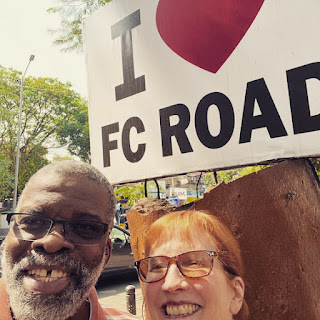
People and Parrots We are here in Pune, India, for my Fulbright Fellowship after a 2-year COVID delay. The Air India flight was as good as a 13-hour flight can be. The transfer in Delhi was a bit stressful as we didn’t know we had to go through Immigration and then come back in through security to board our flight to Pune. Once we arrived at the Pune airport, the hotel driver was right there waiting for us and we made the Ramee Grand Hotel our home for the week. The hotel was quiet and well equipped, but the best parts were the staff and the food. The exemplary staff met our every need, including having the driver take us to an office to get some money changed when we didn’t have success just showing up to a bank. The hotel is a short walk - maybe a kilometer (as it seems everything is just about a kilometer away, even if it isn’t!) from the college. Fergusson College Road (FC Road) is teeming with people, shops, auto-rickshaws, bicycles, cars, cabs, and more people. As in any big city, there were beggars—like NYC there are extremes in India, the poor and the rich cohabit the city. One unique experience was a short, older, Indian woman dressed in a simple saree holding a plate with flowers and colors (maybe for Holi), who walked beside me and then swiped her thumb upward on my forehead…whether in a blessing or a plea for me to purchase something, I’ll never know.
We were encouraged and blessed by the warm welcome we received at Fergusson College. A few days after our initial visit I met with students who expressed an interest in my two classes—Creative Writing and Research Methodology (something for the right brain and the left brain!). Then on Wednesday, we moved into our cottage for the duration in a lovely area of Pune, Aundh. The garden, replete with all kinds of birds I hope to soon identify, was the big selling point for me. The green parrot above was one of dozens, I’m not exaggerating, who live in the trees surrounding the Ramee Grand Hotel. When dusk falls, the parrots come out and fly around from treetop to treetop—an amazing sight. I won’t bore you with the numerous forms, FRRO, SIM card, and other technicalities we had to take care of this first week. All in all, it was a good start to our adventure in India. Stay tuned!

Thursday, September 16, 2021

Normalizing Interracial Relationships

 Fiction has many purposes—to entertain, instruct, expand the mind, change perspective, increase empathy, escape, travel, learn history, solve puzzles, learn about ourselves. Please add your own in the comments below - this list is far from exhaustive. I have found all these purposes at play in my own personal and professional reading. I gravitate toward fiction, but also enjoy the occasional memoir, biography, or history.

I recently read We Hope for Better Things, by Erin Bartels. It’s my favorite genre, historical fiction, covering a time and issue I cover in my historical novel Remnant, slavery in the United States. Bartels’ main characters find love across the color line. Interracial relationships are so common in her novel, they are almost expected. As I read through the reviews of We Hope for Better Things, I was struck by the paucity of comments on interracial relationships. One reviewer, Diane McPhail, writes “her striking protagonists, threaded together by unsuspected ties and deeply buried secrets, emerge as women of unusual strength, ability, and courage in the face of racial injustice. . . Each stands defiantly against cultural norms, in community, and in family, in the era in which they live.” McPhail skirts the issue of interracial relationships but doesn’t tackle it head-on. Very few reviewers mention the fact that the three main protagonists, women spanning three centuries, ALL engaged in interracial relationships. Wow! Isn’t that unusual! Or is it? 

Years ago, when I told my sister the plot of my novel Remnant, she pointed out that I had more than one interracial relationship and that stood out to her. At the time I didn’t even realize it! Of course, I knew my characters and I knew the men and women who formed relationships, but it didn’t strike me as odd or unusual that both my protagonists had interracial relationships. Why? Because interracial relationships are not unusual to me. They’re normal! I’m married interracially, and I know many interracial couples—all kinds of wonderful combinations: Black and White; Puerto Rican and biracial; African and Caucasian American; Chinese and Caucasian American; Indian and Caucasian American; Filipino and Italian; Filipino and African American… the list goes on. It feels like the most natural thing in the world to me. People are attracted to each other for many reasons, and race may or may not be a factor.

Wittingly or unwittingly, Bartels normalizes interracial relationships in We Hope for Better Things. I purposely normalize interracial relationships in Remnant. One of the powers of the written word is to change perspective, and I hope our novels change people’s minds about how ‘normal’ or ‘abnormal’ interracial relationships are—I think they’re normal!


Monday, July 26, 2021

Women and Language

I’m “just” saying - qualifiers and seeking approval undermines female speech

As I work on my novel Remnant, I am using the “find/replace” feature in new ways. With different dialects in the novel, including slave dialect, I wanted to make sure all the instances of “just” were written as ‘jes and not ‘jus. So I did a “find” command with “just” and was shocked at what I saw. In my 400+ page manuscript, there were over 250 uses of “just.” Some of them were appropriate, but in many cases, the word was used by female characters and it undermined or undervalued their speech. 

Sometimes “just” can be replaced with “only,” “simply,” “recently,” or “barely.” Often it is not needed at all - similar to “that,” a word I encourage my students to delete whenever possible. We use “just” and other words like it to soften our speech so we don’t seem so demanding. For instance, “can I just have a cup of coffee?” Or “I just need a moment of your time.” 

I noticed this the last few weeks as I watched Jeopardy. This is a generalization, but I noticed it often enough that I bet a study could be done on how men and women use language to ask for categories on Jeopardy. The men often say “mountains, 200” - in other words, they succinctly say what they want using a shortened form of the category and the amount. On the other hand, women often use qualifiers and say “may I have mountains for 200, please?” They are more polite, but they tend to ask permission more instead of stating what they want.

As I reviewed all the instances of the use of “just” in my novel, I had to make decisions about why the character used that word, if it were appropriate, and if I could either delete it or use a synonym. Take this sentence in the novel: “No, just my papa and his sister were kidnapped.” As I read it again, I wondered how I could use “just” to describe something as heinous as a kidnapping into slavery. It seems glaringly inappropriate at a second glance. Or how about this dialogue? “Don’t worry about my hair.  I can just pin it up.  You have a lot to do.” Here the character is meek and apologetic. Does that fit the personality of my character at this point in the novel?

Have you found helpful uses for the “find/replace” feature in MS Word? Let me know about them in the comments. I’m just saying…

Saturday, June 12, 2021

Using color to convey tone: The Things We Do for Love, Kristin Hannah


As I read Kristin Hannah’s new book, I was struck anew by her descriptive writing, but especially her use of color to convey tone. Descriptions of bright colors seemed to leap off the page. Judicious use of color can add pop and sparkle, enhance the mood, reflect emotion, and provide concrete details that help the reader picture a scene.

Here are a few examples.

White and pink are lively, fun, calm colors:

“…wallpapered in roses and white baskets, held twin beds ruffled in pink bedding” (10)

Alliteration accompanies vivid descriptions: 

“…gleaming gold of her hardwood floors…” (16)

“…long ago painted in bright blues and greens and pale pinks to reflect the Victorian fishing village theme” (22)

Gray is often used to create a somber or depressed tone:

“…the Pacific Ocean was a windblown gray sail that stretched to forever…” (22)

“The sky was an ominous gunmetal gray…” (80).

Color can be used to denote changes:

“…those tiny green leaves would curl and blacken…” (4)

“The shingles, once a cedar red, had aged to the color of driftwood, silvery soft. The white trim was barely a contrast at all” (23)

This is a veritable riot of colors, showcasing the personality of Angie’s sister Livvy through her furnishings and fashion:

“Pale blue velvet sofas faced each other, separated by a glossy wood table. The accent chairs were ornately gilt; the fabric was pink and blue flowers. The sculpted carpet was orange” (68). 

“…she looked like a Bic pen in her black silk sheath…” (7) 

 Contrast the first description of Angie’s mother with the subsequent description of her rich boyfriend David’s home:

“She was porcelain pale; blue-black mascara smudged around her eyes. The faintest hint of her once-great beauty remained, like a glimmer of gold trim on a dirty china plate, peeking through” (36).

 “Beautiful, translucent bone china rimmed in gold sat on ivory silk placemats. Gold flatware glinted in the light of a single candle” (64). 

As I revise my historical novel Remnant, I am cognizant of using color to convey mood, emotion, and detail. Here are a few examples. When the main character and her brother are kidnapped in Africa, the mood is solemn, traumatic, and the colors need to reflect and match the mood:

“…the woman tied a dirty gray rag across my mouth and around the back of my head, forcing my tongue to the back of my throat, and then did the same to Ledu…” 

When I visited Magnolia Gardens, a plantation in South Carolina, I was struck by the juxtaposition of beauty and ugliness. Slavery existed in the south in some stunningly beautiful places. I wanted to convey this sense of dissonance in my novel.

                                            Bridge at Magnolia Plantation and Gardens
                                            https://www.scpictureproject.org/charleston-county/magnolia-plantation.html

“I looked back at the pen where men and women were being sold, and ahead to the ocean, swelling in all its glory.  How could this world be so ugly and so beautiful? As the sun began to set over the horizon, we were momentarily stunned at the beauty of it. The reds and yellows were shot through with purples and pinks, painting the sky with uneven swaths of bright color.”

What have you read lately where color was used to great effect? Or, what are you writing now, and how are you incorporating colors in your writing? I look forward to your comments.

Join me at katiesweeting.com for new blog posts and other updates.

Sunday, May 2, 2021

Northanger Abbey: Catherine Morland, an "accidental feminist"

 Last week I had the awesome privilege to teach a class of graduate students at Fergusson College in Pune, India. Although I couldn’t see the 38 students, I could view their names and we could interact. Even though we tested the technology ahead of time, there were still some glitches: I couldn’t access the chat and my PowerPoint presentation didn’t work in full screen. All of us who teach online or remotely know we need to be flexible. So we soldiered on, overcame the technical deficiencies, and had a wonderful class!

Not being able to use the chat turned out to be a blessing. The questions I would have put in the chat I simply asked aloud, and I got great responses from the students. I was a bit surprised to hear several male voices—either there were a lot of males in the class, or they were just more vocal! Either way, I smiled as I listened to apt interpretations of Northanger Abbey from both the males and females.

To begin I covered the genre of the novel—covering aspects like length, plots and sub-plots, complex characters with inner lives, and entertainment value. I did an elevator speech on Jane Austen—that could take several lectures in itself. Then we took a glance at the theories of literary criticism: Formalism, New Historicism, Psychological (Freudian), Feminist, Archetypal/Mythological, Marxist. I tend to take a New Historicist approach, wanting to know as much as possible about the author and the time period in which she wrote.

                                     Catherine Morland, played by Felicity Jones, from the 2007 
                                        production of  Northanger Abbey directed by Jon Jones

Then we spent the second hour of the class discussing Northanger Abbey in some depth. I asked the class, “Is Catherine Morland a feminist?” Catherine is honest, direct, turns down, and accepts marriage proposals; she speaks her mind to her peers, Isabel Thorpe, and her ‘betters,’ General Tilney. But do these qualities make her a feminist? One of the students offered a brilliant answer to the question. She called Catherine Morland an “accidental feminist.” Maybe she didn’t intend to be a feminist or strive to be a feminist, but for her time period, she really was a feminist!

Catherine Morland was not a feminist in terms of the modern definition of belief and advocacy for equal social, political, and economic status. And she might not have met the standards of Mary Wollstonecraft, though both would agree that a wife is more of a ‘companion’ than an ornament or servant.

What do you think? Was Catherine Morland a feminist? Was she ahead of her time? Please let me know your thoughts by commenting below.

Check out my new website: katiesweeting.com. I'll be discontinuing this blog and blogging from my website in the coming weeks.

Wednesday, February 24, 2021

Historical novel research - Taboo no Longer: Menstruation in 19th Century England

You may wonder why I'm writing a blog on menstruation! Well, I'm revisiting and revising my historical novel Remnant, adding some drama to Joanna's storyline. Joanna Vassa, the daughter of famed abolitionist Olaudah Equiano, died of uterine disease, maybe endometriosis. It's likely she suffered from painful periods and I plan to include this in the novel...hence the research. After spending days on research, it will probably amount to a few paragraphs in the book, but the journey is worth it. 

Joanna came of age during the Regency Era in England, so designated because King George III was mentally incapacitated and his son George took over as Prince Regent from 1811-1830. Following the Regency Era was the Georgian Period, followed by the Victorian Era, from 1837-1901; Queen Victoria was one of England's longest-serving monarchs. My research hit a brick wall when searching for Regency or Georgian information on menstruation, so I had to look back to the Elizabethan Era or ahead to the Victorian Era.

In the Elizabethan Era, theories about menstruation include a necessary balancing of the four humours: pure blood, black bile, yellow bile, and phlegm. A woman's monthly bleeding would return her body to a natural, healthy balance of fluids. Beliefs that menstruating women had magical powers or that menstrual blood could cure diseases abounded. In fact, Roman philosopher Pliny the Elder wrote "that a menstruating woman could stop hail storms and lightning, as well as kill crops" (History). It was common in the Middle Ages for women to simply bleed into their clothes. I really find it hard to picture a woman walking down the street leaving behind a trail of blood!

Middle or Upper-class women were often consigned to bed rest during their monthly cycle in the Victorian Era. Charles Knowlton, who wrote Fruits of Philosophy in 1832, stated that during her menstrual cycle "the woman is said to be unwell, or out of order...dancing in warm rooms, sudden exposure to cold or wet, mental agitations should be avoided as much as possible" (Showalter 84). Men made decisions about what women could or could not do. 

Elaine Showalter points out that "scientific fact and scientific theory were being influenced by the prevailing social or ethical doctrine of women's inferiority...governed by prejudices rather than scientific truth" (Showalter 85). Elizabeth Garrett Anderson, an English physician, pushed back against the theory that women were incapacitated for one week out of every month during their period, and claimed from personal and professional experience that "the extent of female invalidism was greatly exaggerated by male doctors... and that most adult women completely disregard menstruation in relation to their normal activities" (88). 

Victorian women "used outhouses, chamber pots, or a discreet outdoor spot, [women] did not normally wear panties or other clothes that would need to be pulled down" (Freidenfelds). However, during their monthly cycle, women wore some kind of cloth or diaper, often with a belt, a precursor to the first Kotex pads with belts in the 1920s.

I was also curious about what women (and men) called the menstrual cycle in the early 19th century. In the 17th century, they referred to flowers, courses, and terms, as in "she is having her courses." Quite frequently no specific vocabulary would be used at all. Instead, someone might say "she hasn't had those for a while," or they might say she is "in the custom of women" (Reid). 

Interestingly, Natalie Joffe points out that "it was noted that some groups had a rich vocabulary for menstruation, while others had but the scantiest of terms" (Joffe). The Irish have very few words and the French employ a plethora of words, denoting not just their attitude toward menstruation but their attitude toward women's sexual health in general. Words used to denote menstruation often referred either to the monthly frequency-- that time of the month, her time, monthlies-- or the idea that women were not feeling well while menstruating--unwell, the curse. Meigs, writing in 1852, notes that "among us , it is called courses , periods , terms , monthlies , monthly sickness , unwell , times , and a variety of other names , hints , and allusions , that need not be here summed up" (Meigs).

Historical fiction novelists spend weeks, months, or even years conducting research to insure the history is accurate. Finding reliable sources for some topics is quite difficult, as I discovered when simply trying to find out what they called a "period" in 1807!

______________________________________________________

Bibliography

Freidenfelds, Lara. "Period Drama: That Time of the Month in Victorian America." National 

Museum of Civil War Medicine. 12 February 2017 https://www.civilwarmed.org/menstruating/

Hindson, Bethan. “Attitudes Towards Menstruation and Menstrual Blood in Elizabethan England.” Journal of Social History, vol. 43, no. 1, Fall 2009, pp. 89–114. EBSCOhost, doi:10.1353/jsh.0.0246.

Ives, Susanna. "Tidbits on Mid-Victorian Era Menstrual Hygiene." http://susannaives.com/wordpress/2015/09/tidbits-on-mid-victorian-era-menstrual-hygiene/
Joffe, Natalie F. "The Vernacular of Menstruation," WORD, 4:3, 181-186, DOI: 10.1080/00437956.1948.11659341

Meigs, Charles Delucena. Obstetrics: The Science and the Art.

Read, Dr. Sara. Menstruation and the Female Body in Early Modern England. Palgrave Macmillan, 2013.

Showalter, Elaine, and English Showalter. “Victorian Women and Menstruation.” Victorian Studies, vol.14, no. 1, 1970, pp. 83–89. JSTOR, www.jstor.org/stable/3826408. Accessed 22 Feb. 2021.

The History of Periods: How Women Have Dealt With Menstruation Through the Ages. https://www.knixteen.com/blogs/the-rag/the-history-of-periods. 23 May 2018


Saturday, January 9, 2021

Words as symbols


家 

jiā, house

What are words?! Sometimes I like to get back to basics. As someone who deals with words in my personal, social, avocational, and professional life, I like to take a step back and think about what these crazy squiggles on a paper or screen are actually all about!

Words in and of themselves have no meaning. Words are composed of letters, or in some cultures characters. A particular combination of characters is formed to comprise words or larger characters. In Chinese, some characters resemble the idea or meaning of the character. 家 (jiā) means home, family, or house in Mandarin. The original character for home in Chinese was a pictograph of a pig inside a house. The current character has a hog under a roof! The character for house looks like a house. So there is a concept of a house, and there is a corresponding character of house. And for ancient Chinese culture, a house included a hog! The character is given a meaning, and the image of the character resembles the image of the meaning.

The English alphabet derived from the Latin alphabet around the 7th century C.E. -- the very word alphabet is a compound of the first two letters of the Greek alphabet, alpha and beta!!. The origins of the English language hark back to the earliest influence on England -- Germanic peoples known as Angles, Saxons, and Jutes. The Norman (French) influence on the English language is also significant. So what we consider the "English" language is rooted in influences from Latin, Greek, German, Dutch, the Netherlands, and France!

Words are composed of letters (in many languages, like English), and the specific combination of letters in a particular order forms a word that connotes meaning. However, this is where it gets tricky. The meaning I imbue to a word may not match the meaning you give a word. And that is precisely where communication goes awry. We use words and we think we are communicating well, but do we check to ensure the words we are using are understood the way we understand them?! 

In one of my classes, we had a lengthy debate about a word when studying Socrates. The word was DESK. I asked the class, "what is a desk?" Answers included the following: a table with drawers; a rectangular structure where one can work; a place to work; a place to store papers with a top to work on; a table with file drawers. I asked if the table I was at was a desk. Some said "yes" and others said "no." Does a desk need to have drawers? Is a desk defined by how it looks or its function? If I'm sitting in my backyard grading papers on my lap, is my lap a desk?? The word "desk" is composed of symbols, four letters in this order... D.E.S.K. In and of themselves, those letters have no meaning. The word itself has no meaning other than the meaning we give it. As it turns out, we don't all give it the SAME meaning! One simple word we think we all understand, but it turns out there is great confusion!

In the current political climate here in the U.S. words have been misused, misappropriated, and misunderstood. In my next post, I'll examine how words have power, both for good and for evil.

“Words are but symbols for the relations of things to one another and to us; nowhere do they touch on absolute truth…” (Friedrich Nietzsche)

______________________________________________________________________________

https://www.chinasage.info/chars/fch_jia_house.htm


Saturday, December 19, 2020

The Word: Logos

 Words fascinate me. As I wrote in the previous post, I deal with words, in words, and around words on a daily basis. I write words, read words, grade the written word, and speak words. Words have power--to enlighten, to heal, to change a perspective, to hurt, to encourage, to challenge, to express love. 

For the next few blog posts,  I'll delve deeper into the meaning and purpose of words--the relationship between ideas, words, and culture; how and why words are so often misinterpreted; how certain combinations of words have more impact; and how we can use words to change the world! For now, we'll start at the beginning.

The first verse in the bible is Genesis 1:1: "In the beginning God created the heavens and the earth." The word genesis means the beginning or formation of something. So Genesis 1 is the beginning of the beginning! And who was there in the beginning? God! Jews, Christians, and Muslims all hold the Hebrew Bible/Old Testament as a sacred book and believe God created the heavens and the earth.


Skip ahead in the Bible to John 1:1-3: "In the beginning was the Word, and the Word was with God, and the Word was God. He was with God in the beginning. All things were made through Him and without him nothing was made that has been made." So God created the world, heaven and earth, in the beginning, and the Word, Logos in Greek, was there. The Word, Logos, is Jesus. Jesus was present in creation with God the Father and God the Holy Spirit, speaking the universe into existence: "And God said, 'Let there be light,' and there was light," Genesis 1:3. 

The word logos has its origins in Greek philosophy and relates to the power of reason. According to Stoic philosophers in the 3rd century B.C.E., logos is the "active rational and spiritual principle that permeated all reality. They called the logos providence, nature, god, and the soul of the universe." By referring to Jesus as logos, the Apostle John is signalling that Jesus is the co-creator with God the Father, the One whose words reflect spiritual and physical reality. In addition, Jewish rabbis referred to God as "the word of God," so in a few short sentences the Apostle John is appealing to Jews and Greeks, and laying a foundation for the spiritual concept of the Trinity -- three co-equal aspects of God.

Our ability to use words to communicate thoughts originates in the creator of words, God Himself, and in the Word, Jesus Christ. God used words to create life. As we begin to explore the meaning and power of words, we start with the Word, Logos, the Messiah whose birth we celebrate this week, Jesus the Christ.

__________________________________________________________

Holy Bible. New International Version. Cornerstone Bible Publishers, 1984.

"Logos." Encyclopædia Britannica. 20 May 2020. https://www.britannica.com/topic/logos


Sunday, November 22, 2020

Are You a True Reader or a Book Nerd?

Not a day goes by when I don't read. I read the bible daily, and I am also usually reading a novel; articles online; student work; texts and email messages; recipes. I can't imagine a day without reading as an integral part. But none of these activities make me a "true reader" according to C.S. Lewis, beloved and renowned Christian author, professor, scholar, and novelist. Lewis highlights a few characteristics of a "true reader" in his book (compiled from letters and writings) The Reading Life: The Joy of Seeing New Worlds Through Others' Eyes

C.S. Lewis has been described as "the best-read man of his generation, one who read everything and remembered everything he read" (Epmson, qtd in Lewis). Anyone who is reading John Milton's Paradise Lost at ten years old and Shakespeare at eleven is beyond erudite! So Lewis's ethos argument is strong--he has earned the right to qualify who earns the title of "true reader." See if you pass these four tests of a "true reader" C.S. Lewis uses to separate the serious from the inconsequential! 

 1) Loves to re-read books 
    Have you ever purposely re-read a book? I read so many books, some serious literary tomes, and some lighthearted romances, that I can forget I read a book. This has happened more times than I'd like to admit, and I usually reach a point where it seems so familiar that I realize I have read the book previously. At that point, I sometimes continue and finish the book, and other times set it aside.
    I'm a member of JASNA (Jane Austen Society of North America). Any good Janeite will tell you how many times they have read each of Austen's six books. I remember hearing a Janeite say at a conference, "Oh, I didn't realize that until my thirteenth reading of Persuasion." Some books beg to be re-read. Why re-read a book? It's not for the plot - we already know the plot. We re-read for the lyrical prose, for how the book makes us feel, and think, and see differently.

 2) Highly values reading as an activity 
    I read daily because I love to read. Now that I'm on Goodreads it's easier to keep track, but I generally read 4-6 books a month. Do you read because you love to read, or because there is nothing else to do? When I travel I always have my iPad, or Nook, plus a few actual books. I can remember when I was a pre-teen I would get together with my friend Connie and we would spend the afternoon sitting outside each engrossed in our own book. Yep, I'm a book nerd.

 3) Lists the reading of particular books as a life-changing experience 
    Books have changed my perspective, taken me to the past and the future, provided hours of enjoyment and suspense, and made me a more empathetic person. First, the Bible has changed my life and revealed spiritual truth. All other books pale in comparison to the impact of the Bible on my life. 
    Second, authors who have greatly impacted me include Jane Austen, Charles Dickens, Charlotte Bronte, Geoffrey Chaucer, William Shakespeare, Chinua Achebe, Chimamanda Ngozi Adichie, Alexandre Dumas, Leo Tolstoy, Tracy Chevalier, Jojo Moyes, Philippa Gregory, Barbara Kingsolver, Olaudah Equiano, Noah Gordon, Langston Hughes, Sophocles, Homer, Ann Patchett, Mark Twain, Emily Dickinson, Herman Melville, Vikram Seth, Thrity Umrigar, Jhumpa Lahiri, Maeve Binchy, Rosalind Laker, Ann Tyler, .... and too many more to name.

 4) Continuously reflects on and recalls what one has read 
    (these four points are taken from The Reading Life by C.S. Lewis).
    Book groups are great. I'm not in a book group right now, but I love sitting around and talking about books. Book groups are one way to reflect on what we've read. I guess some of my literature classes are like book groups in the sense that we read and discuss literature. But there are other ways to reflect on books - writing reviews, journaling, and talking to friends. When a book simply blows me away I write a review -- it comes out of the life-changing experience of reading the book and I'm compelled to share my experience with other readers. I also blog about my favorite books!

    What do you think? Do you meet all four of these criteria and qualify as a True Reader, according to C.S. Lewis. Or, if you'd like another evaluation to determine if you're a Book Nerd, take this quiz: https://www.barnesandnoble.com/blog/whats-your-book-nerd-score/

    What's the verdict? Are you a True Reader or  Book Nerd?

_______________________________________________________

Lewis, C.S. The Reading Life, The Joy of Seeing New Worlds Through Others' Eyes. Harper One, 2019.


Saturday, November 14, 2020

Where the Crawdads Sing - Paean to the marsh

Don't you hate it when book descriptions are imprecise or inaccurate? I have avoided reading Where the Crawdads Sing because I was told it was mainly about an abusive father. An abusive father plays a role in the book, maybe a pivotal role, but he is not the most important character, and in fact, his part on the book's stage is small.

Order here 
Rather, the book is a love song to the marsh and the Marsh Girl. Delia Owens' lyrical writing about nature reminds me of Tracy Chevalier's At the Edge of the Orchard, or Remarkable Creatures, or Barbara Kingsolver's Flight Behavior or Prodigal Summer. Interestingly, Barbara Kingsolver has a degree in biology and Delia Owens is a zoologist.

The book is about survival - Kya, aka the Marsh Girl, is abandoned by everyone. Her mother leaves, then all her siblings leave, and finally, her abusive father leaves. She lives alone in a shack at the edge of a marsh in North Carolina - alone as in there were no other humans around. With only one day of formal schooling, and no adults to guide her, she survives. When she becomes a young woman, two men come into and out of her life, and she survives their betrayal, too.

Kya's best friends are the seagulls, the great blue heron (one of my favorite birds), and Cooper's Hawk. Owens describes the great blue heron as "the color of gray mist reflecting in blue water" who walks slowly "like a predacious bridesmaid" (Owens 109). Kya is so intimately attuned to the creatures who inhabit the marsh, she takes on some of their characteristics (read the book to find out what I mean). Kya observes the birds, insects, amphibians, and sea creatures and even mimics some of their behavior. Owens' writing almost has me scratching imaginary mosquito bites and feeling the cool mud on my feet -- it's that descriptive and engaging.

Like the best writers, her analogies and descriptions are original, yet with a veracity that makes them feel obvious. She describes the nearby town as "quite literally a backwater town, bits scattered here and there among the estuaries and reeds like an egret's nest flung by the wind" (Owens 32). And her analogies, similes, and metaphors reflect the natural world of the novel, so Kya is depicted as "trying to disappear like a bark beetle blending into the furrowed trunk of an oak" (Owens 45).

When her only real friend, Tate, teaches her to read, she reads this line: "there are some who can live without wild things, and some who cannot" (Owens 125). Kya exclaims, "I wadn't aware that words could hold so much. I didn't know a sentence could be so full" (Owens 125). Indeed, I feel like Kya when I read the book - who knew sentences could be so full!

There is a plot, and it has enough twists and turns to keep the reader engaged. But the plot is not what made me love this book. The descriptions of the birds and Kya's relationship to the birds, how she crafts a life for herself, albeit lonely, and how she survives kept me riveted.

Have you read Where the Crawdads Sing? Did you love it as much as I do?!

___________________________________________________________________________

Owens, Delia. Where the Crawdads Sing. G.P. Putnam's Sons, 2018.

Friday, November 6, 2020

A Community of the Curious - Writing and researching historical fiction

 I love research! My students question my sanity, but honestly one of the parts of writing historical fiction I love the best is the research--so much so that I need to forcibly stop myself from continuing to research and start writing my novel. I'm revisiting and revising my historical novel about the daughter (Joanna Vassa) and sister (name unknown) of Olaudah Equiano. In the process of conducting research, I came across three scholars/historians and Equiano aficionados. They are part of a community of the curious about Joanna Vassa. I'm a card-carrying member now, too.

Dr. Angelina Osborne's research uncovered documents about Joanna Vassa and information about her life, which she published in a book entitled Equiano's Daughter, The Life and Times of Joanna Vassa. Momentum Arts in Cambridge published the book as part of the Untold Stories Arts and Heritage Project designed to highlight the lives of Cambridgeshire's Black and Minority Ethnic people. Nine years ago I undertook a pilgrimage to England to visit the sites where Equiano lived and wrote, Joanna's grave, The Congregational Church in Clavering where her husband was minister, and William Wilberforce's museum in Hull. 

Dr. Vincent Carretta is another member of the community of the curious. His research led him to write a seminal biography of Equiano, Equiano the African: Biography of a Self-Made Man

Arthur Torrington, CBE, is a Guyanese-born community advocate and historian who co-founded the Equiano Society in London in 1996. He personally took me on a tour of the spots in London where Equiano is known to have lived and worked and brought me to Joanna Vassa's gravesite in Abney Park Cemetery. The Equiano Society recently hosted a Zoom event on Joanna Vassa, and Dr. Vin Carretta was one of the speakers.

The community of the curious about Equiano, his life, and his family continues to grow. I am honored and delighted to be part of this particular community of the curious about Joanna Vassa.

What kinds of wonderful people have come into your life through your research?


Saturday, October 31, 2020

Centering the marginalized ... in fiction


According to Merriam-Webster.com, marginalized means "relegated to a marginal position within a society or group."

"Refugees are the world's quintessentially marginalized population: They are by definition located at the edge, beyond boundaries, on the outside."    — Tamar Mayer"… the domination and oppression of women and other marginalized groups within patriarchal culture."    — Susan M. Squier
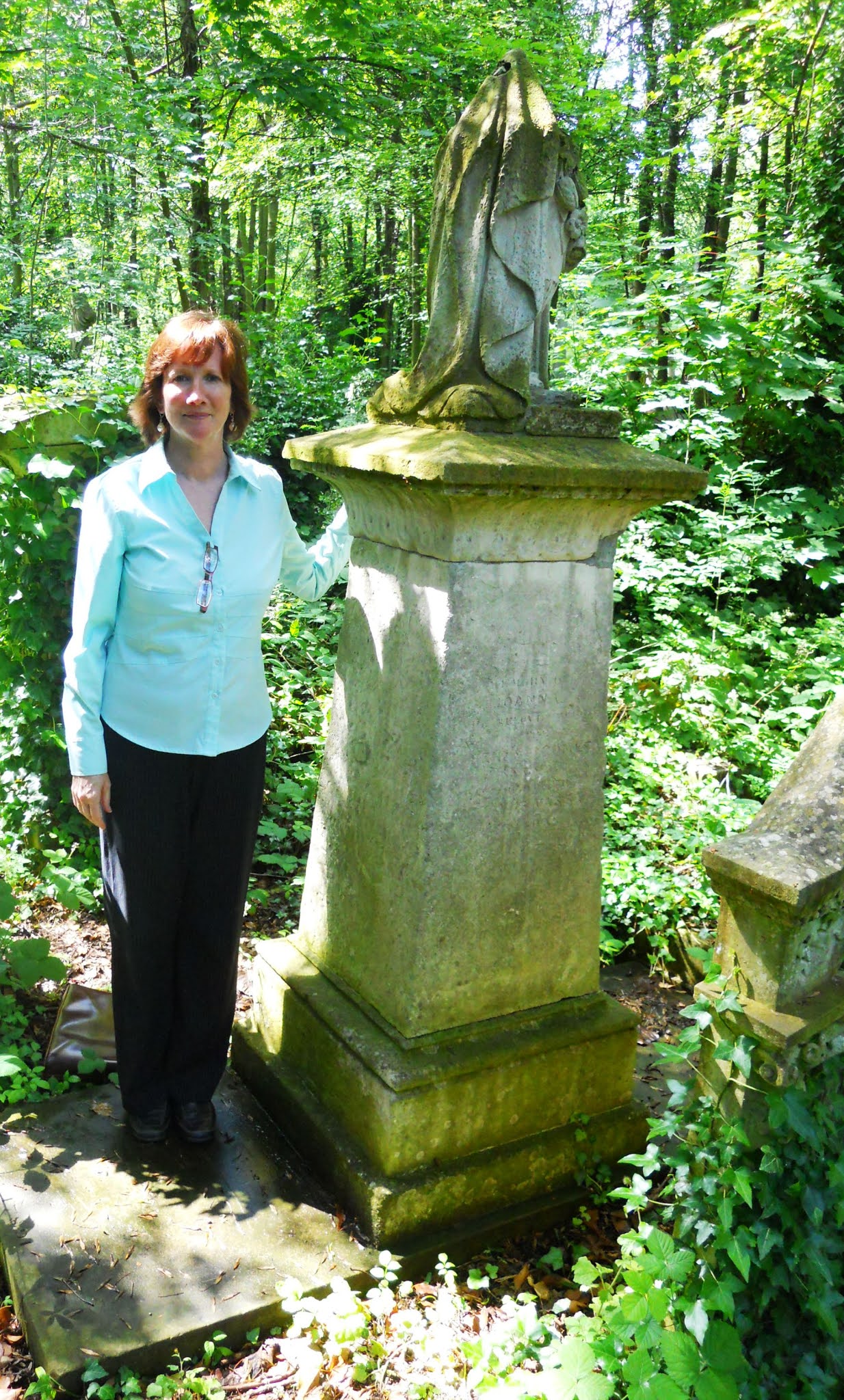
Katie at Joanna Vassa's grave
Joanna Vassa's grave at
Abney Park Cemetery
Marginalized - the first image that comes to mind is a sheet of paper with margins. The margins are purposely blank. The important information is inside the margins. But what does it mean to be marginalized? Society deems certain people, certain groups, usually the oppressed, unfortunate, those struggling for equity and opportunity, and often people outside the bounds of "the norm" -- marginalized.
Who says? Should we accept this relegation to the margins? No! I say let's shift our perspective. Maybe those who have been shuffled off to the margins should be in the center. And even more radical... maybe those consigning people to the margins should be marginalized themselves!Who is marginalized in American society today? Those who don't have a home or a job or hearing or vision or mobility -- they are identified by what they do not have rather than what they do have. Those who occupy an extreme... too dark, too small, too big, too flamboyant, too religious, too political. I've been thinking about the issue of marginalization in relation to the two novels I have written. My first novel, Remnant, a historical novel about the daughter (Joanna Vassa) and sister of Olaudah Equiano. Equiano wrote and self-published his autobiography in 1789 and became the richest African living in England in his day. He married a white woman, Susannah Cullen, and they had two daughters. By 1797 Equiano, also known as Gustavas Vassa, Susannah, and their firstborn daughter Anna Maria had all died, leaving Joanna Vassa a bi-racial two-year-old orphaned. Joanna could be the poster child for a definition of "marginalized" (except for the fact that her family had money and she inherited a tidy sum of £950 when she turned 21). Even the grave of Joanna Vassa was marginalized until Prof. Vincent Carretta discovered it covered in weeds and lying on its side, and brought it to the loving attention of the Abney Park Cemetery staff. He centered her grave. Additionally, Equiano's final resting place was unknown until recently, when Prof. Carretta aided by Equiano Society associate David Gleave found this record in church archives: “6 [April 1797] Gustus Vasa, 52 years, St Mary Le bone.” Equiano is buried in the cemetery next to the former Whitefield’s Tabernacle in Tottenham Court Road (currently the American International Church). Equiano's gravesite location has been centered.Susannah Cullen married Olaudah Equiano - interracial couple #1. Joanna Vassa marries Henry Bromley - interracial couple #2 (these are both historical). Olu (Equiano's sister) marries Teddy - interracial couple #3 (fictional). I'm moving the marginalized (interracial couples) to the center. I'm centering the marginalized in my writing.In my second, contemporary novel, Expecting, the main characteMichaela is traumatized when her mother dies in childbirth, leaving her with a fear of childbirth and determination to become an obstetrician, and preventing her from accepting Victor’s advances…the Deaf man with whom she has fallen in love. My Deaf characters in the novel are in the center of the action, not on the margins. In Expecting, it is normal to be Deaf. I center the marginalized.How do you "center the marginalized" in your writing?

Saturday, October 24, 2020

A Long Petal of the Sea : Why I love historical fiction

 “One of the most richly imagined portrayals of the Spanish Civil War to date, and one of the strongest and most affecting works in [Isabel Allende’s] long career.”—The New York Times Book Review


I'm a big fan of historical fiction. It's my favorite genre. A Long Petal of the Sea has all the elements I love in historical fiction: a good story, well told, set in a historical time and place, with both historical and fictional characters with whom I would love to sit down and have a cup of tea!

A Long Petal of the Sea covers the mid-1930s in Spain, to the 40s-90s in Chile (with brief stops in Spain, the U.S., and Venezuela). If you had asked me anything about the Spanish Civil War before I read this book, I would have a blank look on my face. Whether I ever learned about it (doubtful) or have just forgotten (possible) I could not have related any details whatsoever. Having lived through Allende's fictional retelling, I can now almost picture the war between the Catalonians and the Fascists - with Franco defeating the indefatigable Republican Spaniards. If I want the facts of the Spanish Civil War, I can read a book, or an essay (or Wikipedia!). I will learn about the two sides, the Republicans versus and Nationalists, with "communists" against "Christians" the rallying cry. But if I want to get a sense of history, and engage my senses, I read historical fiction. Through Allende's masterful writing I can smell the fires, feel the fear, cringe at the deprivation and cruelty, and see the destroyed city of Barcelona. 

The book is also a paean to Pablo Neruda, Chilean poet and diplomat. Neruda transported over 2,000 Spanish refugees living in sub-human conditions in concentration camps in France, having fled at the end of the Spanish Civil War, in a ship called the Winnipeg to their new home in Chile. The title comes from Neruda's poetic description of the country of Chile.

For more on this fascinating moment in history, read this: 

https://socialistaction.org/2019/09/25/the-ss-winnipeg-pablo-neruda-and-a-long-petal-of-the-sea/

It strikes me that this book is particularly apt in our present day when fascism and nationalism are on the rise in many countries, and the lines that so starkly divide us get wider every day, becoming more like chasms than lines. 

"Those who cannot remember the past are condemned to repeat it." (George Santayana, Spanish-American philosopher, poet, and novelist). 


Wednesday, September 2, 2020

Gilgamesh - the first "bromance"

 The first day of school - how different it looks in the midst of the COVID 19 pandemic. This is what my first day of school looks like today. 


I'll be teaching all my classes either fully online, or remotely: Speech, Composition 1, Religions of the West, and World Literature to 1650. Yep - four preps. Don't tell my students, but I'm most looking forward to World Literature to 1650.

I designed two World Literature classes over 10 years ago, and have taught both of them multiple times. If you look back in this blog to 2012 you'll see a blog on Gilgamesh. For the past few years, I have taught British Literature, which is great fun, but I'm happy to be back with my old pals Gilgamesh and Enkidu!

Gilgamesh is the first extant literature, written initially in Sumerian as poetry in 2100 B.C.E., and adapted in Babylonian a few hundred years later. It was very popular during its time, but disappeared sometime in the 7th century B.C.E. If not for an English explorer, Austen Henry Layard, digging up the tablets in the 1850s, and the discovery by George Smith at the British Museum in London that the epic contained a flood account similar to the biblical flood, Gilgamesh may have remained in obscurity. Thank you, gentlemen!

What makes ancient literature so relatable, so endearing, so indestructible? The tropes in ancient literature are echoed in modern-day society. Those age-old themes of man against man, man against himself, man against God/gods, and the quest for immortality, a legacy, a place in history... these are not just ancient. They are very modern. Lin-Manuel Miranda understood this when he wrote the songs to the hit musical Hamilton. Alexander Hamilton sought to make a difference, to be remembered, to live on in his words. He fought against men, against God, and against his own baser instincts. His story is popular today because we can relate. He had his band of close friends - John Laurens, the Marquis de Lafayette, and Hercules Mulligan. Some of the content of the letters between John Laurens and Alexander Hamilton may portend a homoerotic relationship. This is also the case in Gilgamesh! 

Gilgamesh and Enkidu - what can I say. They are a mismatched pair, for certain. One is the urban, urbane male. Gilgamesh does have a few, shall we say, character flaws. He sleeps with all the women of Uruk before their husbands can and drafts all the young men into the army. The people complain to the gods, so they create a "companion" for Gilgamesh -- enter Enkidu. "To his stormy heart, let that one be equal" (Foster 22). 

Gilgamesh and Enkidu have the first "bromance" in literature! Gilgamesh's mother Ninsun tells him his dream about Enkidu means he "will fall in love with him and caress him like a woman" (Foster 29). After Gilgamesh and Enkidu meet, they engage in a fierce wrestling match. My male students tell me many of their friendships started as a fight or a conflict! After Gilgamesh prevailed "they kissed each other and made friends" (Foster 31). Keep in mind, in that culture men kissed as a sign of friendship; they still do in many Middle Eastern countries. Were Gilgamesh and Enkidu friends, or lovers? There are arguments to be made on both sides.

In my next post, we'll look at Gilgamesh's quest for immortality.

_________________________________________________________________________________
Foster, Benjamin, translater. GilgameshThe Norton Anthology of World Literature, Shorter Fourth 
       Edition, edited by Martin Puchner, et al. WW Norton & Company, 2019.